
Selling branded products on Amazon can create valuable opportunities, but it also gives sellers an important responsibility: every item must be genuine, correctly described, properly sourced, and supported by reliable business records.
The challenge is that a product can look authentic while still creating sourcing problems. A seller may receive genuine-looking inventory from an unknown supplier, list it under the wrong ASIN, receive an incomplete invoice, or discover that the supplier cannot be contacted when Amazon requests verification.
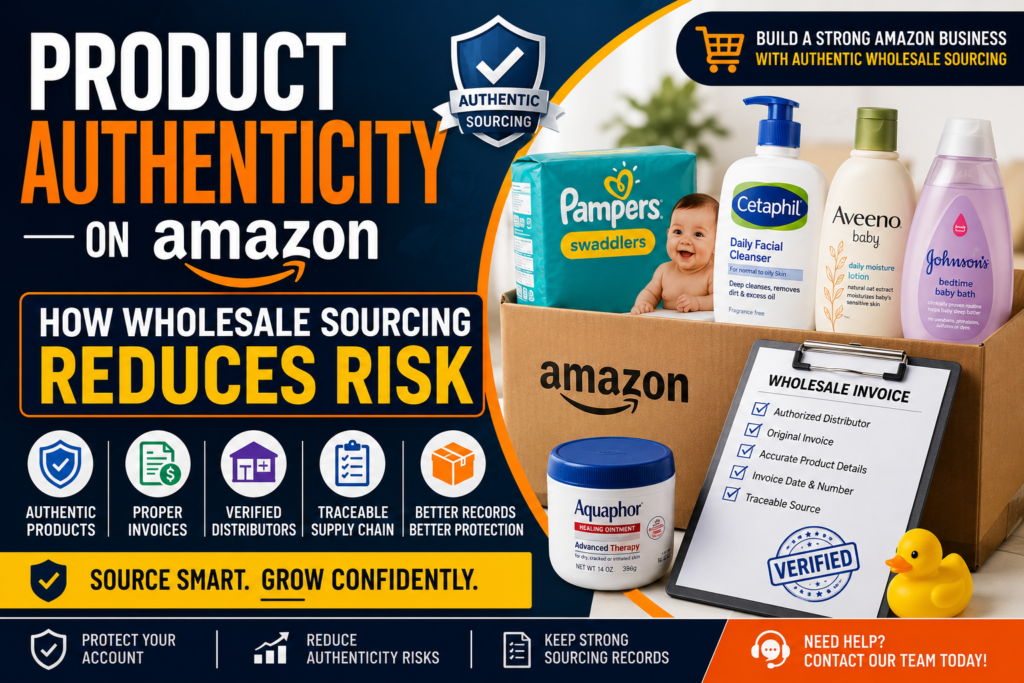
That is why product authenticity on Amazon starts before inventory reaches a fulfillment center. It begins with the supplier you choose, the questions you ask, the documents you receive, and the records you maintain.
As explained in our previous guide on how to verify a wholesale distributor, supplier verification should happen before payment—not after a listing or account issue appears.
Quick Answer
How does wholesale sourcing reduce product authenticity risks on Amazon?
Wholesale sourcing can reduce risk when sellers purchase products from a traceable distributor, receive detailed commercial invoices, verify product identifiers, confirm selling eligibility, inspect inventory, and keep organized transaction records.
These steps do not guarantee Amazon approval or prevent every authenticity complaint. However, they can help sellers demonstrate where their products came from and respond more effectively if Amazon requests sourcing documentation.
Amazon recommends researching suppliers, verifying the authenticity and quality of products, and retaining records such as invoices and purchase orders.
What Does Product Authenticity Mean on Amazon?
Product authenticity means that an item is genuine and comes from the brand or manufacturer represented on the listing. It should not be counterfeit, materially altered, incorrectly branded, or presented as a different version of the product.
For Amazon wholesale sellers, authenticity also involves traceability. A seller should be able to explain:
- Where the product was purchased
- Who supplied the inventory
- Whether the supplier is a legitimate business
- Whether the product matches the selected ASIN
- Whether the purchased quantity supports the inventory sold
- Whether the transaction is supported by an original invoice
- Whether additional authorization documents are available when required
A product may be genuine, but weak sourcing records can still make an authenticity review difficult. For example, Amazon may be unable to verify a supplier if the invoice contains incomplete contact information or the business cannot confirm the transaction.
AI Snippet Answer
What is proof of product authenticity for Amazon sellers?
Proof of product authenticity may include original wholesale invoices, supplier contact information, payment records, purchase orders, shipping records, product photographs, and supply-chain documentation. The exact documents required depend on Amazon’s instructions, the product, the complaint, and the marketplace.
An invoice is supporting evidence, not an automatic guarantee of approval.
Why Product Authenticity Matters for Amazon FBA Sellers
Product authenticity matters because customers expect to receive the exact branded product shown on the Amazon listing. When the received item appears different, damaged, used, expired, improperly packaged, or suspicious, the customer may submit a complaint or return request.
Authenticity problems can also affect a seller’s ability to list certain products and maintain healthy account records.
It Protects Customer Trust
Customers rely on the brand name, photographs, product details, size, pack count, and condition information shown on the listing.
Problems can occur when:
- The packaging design is different
- The seal is broken
- A multipack contains the wrong quantity
- The product is expired or close to expiration
- The UPC does not match
- The product is listed against the wrong variation
- Accessories or instructions are missing
- The product appears used or repackaged
Even a genuine product can create complaints when it does not match the customer’s expectations or the listing information.
It Supports Better Documentation
Amazon may request invoices or other sourcing information for certain selling applications, authenticity reviews, or policy matters. Amazon’s invoice guidance states that submitted invoices should contain identifiable supplier information, product details, and transaction information.
Buying from a professional distributor can help sellers maintain:
- Clear proof of purchase
- Supplier contact details
- Product-level order history
- Quantity records
- Payment evidence
- Shipment information
- Restocking records
These records can help sellers respond in a more organized way when documentation is requested.
It Can Affect Selling Eligibility
Some products, categories, and brands require approval before a seller can list them. Seller Central may display either “Sell this product” or “Apply to sell,” depending on the seller’s eligibility and the product’s requirements.
A product being available from a wholesaler does not mean every Amazon account is eligible to sell it. Requirements may vary by brand, ASIN, category, marketplace, and seller account.
It Supports Account Health Management
Authenticity complaints, product-condition complaints, intellectual-property concerns, and incorrect listing matches may create account health issues.
Wholesale sourcing cannot remove all risk. However, buying through a traceable supplier and maintaining proper documents can help sellers avoid preventable problems caused by unknown inventory sources, informal receipts, or mismatched products.
Step-by-Step Guide to Reducing Authenticity Risk
Step 1: Check Your Eligibility Before Buying
Search for the exact product in Seller Central before placing a wholesale order.
Confirm:
- Whether your account can sell the ASIN
- Whether an application is required
- Whether invoices are requested
- Whether product photographs are required
- Whether brand authorization is requested
- Whether compliance documents are needed
- Whether the item is eligible for FBA
- Whether condition or marketplace restrictions apply
Do not assume that another seller’s ability to list the product means your account has the same access.
Step 2: Verify the Wholesale Supplier
A supplier should be treated as a business partner, not simply a source of low-priced inventory.
Review the supplier’s:
- Legal business name
- Physical address
- Phone number
- Business email address
- Website
- Product categories
- Invoice process
- Payment instructions
- Shipping policies
- Communication quality
You can review the background and sourcing approach of EN Distributions before beginning the account application process.
For a more detailed supplier-checking process, read our guide on verifying a wholesale distributor before purchasing inventory.
Step 3: Understand the Supplier’s Relationship With the Brand
Ask how the supplier obtains the inventory.
Useful questions include:
- Do you purchase directly from the brand?
- Are you an authorized distributor?
- Do you source through another verified distributor?
- Is the inventory closeout or liquidation stock?
- Can the supply chain be documented?
- Are there resale-channel restrictions?
- Is brand authorization available when required?
An authorized distributor and a general wholesaler are not always the same. An authorized distributor normally has a recognized relationship with a manufacturer or brand, while a wholesale supplier is a broader term for a company selling products in bulk.
Our guide to the difference between an authorized distributor and a wholesale supplier explains why this distinction matters for Amazon sellers.
Step 4: Request a Proper Wholesale Invoice
Ask about the invoice before making payment.
A professional wholesale invoice should generally include:
- Supplier’s legal business name
- Supplier’s address and contact details
- Buyer’s legal business name
- Buyer’s business address
- Invoice number
- Invoice date
- Product descriptions
- Product identifiers where available
- Quantities purchased
- Unit prices
- Total transaction value
The buyer’s information should match the business information connected to the seller account wherever possible.
Amazon’s wholesale-sourcing guidance recommends keeping purchasing invoices and notes that sellers may need an invoice from a manufacturer or distributor—or authorization from a brand—when a product requires approval.
A valid invoice may help support approval requests or authenticity reviews, depending on Amazon’s requirements. It does not guarantee ungating or approval.
Step 5: Match Every Product to the Correct ASIN
Do not rely only on the brand name or general product title.
Compare the wholesale product with the Amazon listing by checking:
- UPC or EAN
- ASIN
- Model number
- Brand
- Product size
- Color or scent
- Pack count
- Variation
- Packaging design
- Included accessories
- Expiration date, where applicable
For example, a single unit and a two-pack may look almost identical but belong to different listings. Sending a single unit against a two-pack listing can lead to returns and complaints even when the product is authentic.
Step 6: Inspect Inventory After Delivery
Check the shipment before sending it to Amazon FBA.
Look for:
- Broken seals
- Damaged packaging
- Leakage
- Missing labels
- Incorrect quantities
- Different packaging versions
- Expired products
- Missing batch or lot information
- Used or opened items
- Products that do not match the invoice
Photograph damaged cartons, product labels, case packs, and shipment discrepancies. Contact the distributor promptly if anything is missing or inconsistent.
Step 7: Keep the Original Documents
Create a digital sourcing folder for every supplier and purchase order.
Save:
- Original invoice
- Purchase order
- Payment confirmation
- Shipment tracking
- Delivery records
- Product photographs
- Supplier emails
- Authorization documents
- ASIN and SKU information
- FBA shipment records
Do not alter, recreate, or backdate invoices. Keep the original files provided during the completed transaction.
Step 8: Begin With a Manageable Order
A smaller initial order allows you to assess the complete sourcing process before committing more capital.
Evaluate:
- Product condition
- Listing accuracy
- Invoice quality
- Supplier communication
- FBA preparation requirements
- Sales performance
- Return reasons
- Reordering reliability
A controlled first order may reduce financial exposure if the product becomes restricted, the listing changes, or the supplier’s service does not meet expectations.
Common Product Authenticity Mistakes to Avoid
Buying From an Unknown Source Because the Price Is Low
An unusually low price should lead to more questions, not a rushed purchase. The products may be damaged, outdated, restricted, incorrectly described, or difficult to trace.
Using Retail Receipts as Wholesale Records
Retail receipts may not contain the detailed buyer, supplier, product, and transaction information available on a commercial invoice.
Checking Restrictions After Ordering
Always check selling eligibility before paying for inventory. Otherwise, you may purchase products that your account cannot list.
Submitting Edited Invoices
Changing product descriptions, quantities, dates, addresses, or supplier information can damage the credibility of the documents. Submit authentic and unaltered records.
Assuming “Authorized” Means Automatic Approval
An authorized distributor may offer clearer traceability, but Amazon still makes its own approval decisions. Supplier status does not guarantee category, brand, or ASIN approval.
Ignoring Product Variations
A different size, model, scent, pack count, or packaging version can create a listing mismatch. Match the exact product—not just the general name.
These mistakes are explored further in our guide to Amazon FBA sourcing mistakes new sellers should avoid.
How a Verified Wholesale Distributor Can Help
A verified wholesale distributor can make the sourcing process more structured by providing identifiable products, business contact information, commercial invoices, and consistent transaction records.
A professional distributor may help sellers with:
- Access to wholesale inventory
- Product and case-pack information
- Detailed commercial invoices
- Category-based product options
- Repeat ordering
- Supplier communication
- Shipment documentation
- Better sourcing records
However, a distributor cannot control Amazon’s final decision. Approval requests, ungating applications, authenticity reviews, and account health outcomes depend on Amazon’s current requirements and the seller’s specific situation.
Sellers can visit the EN Distributions website to review wholesale product categories and available sourcing information.
Final Thoughts
Product authenticity on Amazon is not only about whether a product looks genuine. It is also about whether the seller can trace the product, identify the supplier, match the inventory to the correct listing, and produce reliable sourcing records when needed.
Before purchasing inventory:
- Confirm selling eligibility
- Verify the distributor
- Understand the supply chain
- Review the invoice format
- Match the exact ASIN
- Inspect the delivered products
- Keep every original record
These habits do not guarantee Amazon approval, but they can reduce avoidable sourcing risks and help sellers operate a more organized wholesale business.
Ready to explore authentic wholesale inventory? Review the product categories available through EN Distributions, apply for a wholesale account, or contact the distributor to discuss products, invoices, ordering requirements, and availability.
Frequently Asked Questions
1. How can Amazon sellers prove that products are authentic?
Sellers may use original wholesale invoices, supplier information, payment records, shipping documents, product photographs, and supply-chain records. The exact requirements depend on Amazon’s request.
2. Does a wholesale invoice guarantee Amazon approval?
No. A complete invoice may help support an approval request or authenticity review, but Amazon makes the final decision based on its current requirements.
3. Should I buy only from authorized distributors?
An authorized distributor may provide clearer brand relationships and product traceability. However, sellers should still verify the invoice, product details, selling eligibility, and marketplace requirements.
4. What should I check on a product before sending it to FBA?
Check the UPC, ASIN, brand, model, size, pack count, packaging, condition, expiration date, safety seals, and included accessories.
5. Can genuine products still receive authenticity complaints?
Yes. Complaints may occur because of damaged packaging, incorrect listing matches, missing parts, product-condition issues, or customer concerns. Reliable sourcing records can help sellers respond more effectively.