
Choosing a wholesale product category can feel simple at first. You find products with demand, compare wholesale and selling prices, and place an order.
In reality, category selection affects nearly every part of an Amazon FBA business. It can influence approval requirements, competition, storage costs, return rates, product condition risks, documentation needs, and how quickly inventory sells.
A product that looks profitable on a research tool may still be unsuitable for your account. The brand may be restricted, the listing may already have too many sellers, the product may expire quickly, or the supplier may not provide documentation that supports your sourcing records.
This guide explains some of the best wholesale product categories for Amazon FBA sellers and shows how to evaluate them before committing your money.
Quick Answer
What are the best wholesale product categories for Amazon FBA sellers?
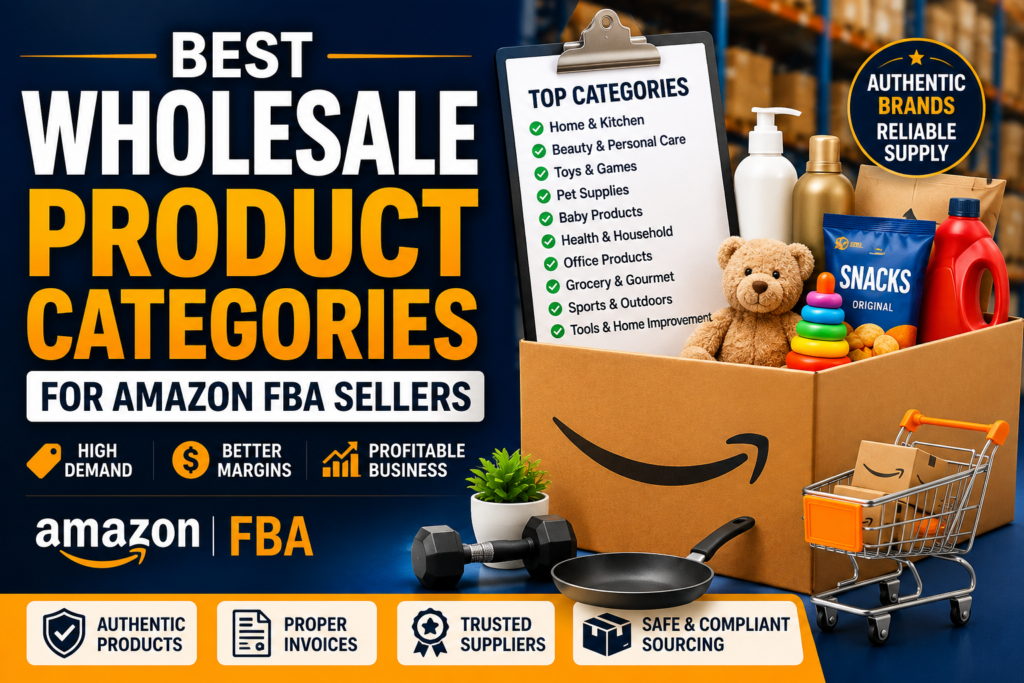
Popular wholesale categories include:
- Home and kitchen
- Office products
- Toys and games
- Pet supplies
- Beauty and personal care
- Grocery and gourmet food
- Baby products
- Health and household
- Sports and outdoors
- Tools and home improvement
The best category for a seller depends on account eligibility, supplier access, competition, margins, product condition, storage requirements, and Amazon’s current rules.
A strong category is not simply one with high sales. It should also offer authentic supply, manageable competition, acceptable fees, clear product matching, and reliable documentation.
What Makes a Wholesale Category Suitable for Amazon FBA?
A good wholesale category provides more than attractive sales volume. It should fit your budget, operational experience, supplier network, and Amazon seller account.
Before choosing a category, evaluate the following factors.
Consistent Customer Demand
Look for products that customers purchase throughout the year rather than items driven only by a short trend.
Seasonal products can still be profitable, but they require careful forecasting. Ordering too late may leave you with inventory after demand falls.
Reliable Wholesale Supply
You should be able to restock successful products without rebuilding your entire supplier network.
A reliable supplier should provide accurate product information, professional invoices, consistent quantities, and traceable business details.
Manageable Competition
Avoid judging competition only by the number of sellers.
Review:
- Whether Amazon sells the product
- The number of FBA sellers
- Buy Box rotation
- Price stability
- Seller review strength
- Listing quality
- Whether new sellers frequently enter the listing
A listing with fewer sellers may still be difficult if one dominant seller controls the Buy Box.
Reasonable Return and Damage Risk
Some products are more likely to be returned because of sizing, compatibility, personal preference, or fragile packaging.
Returns can reduce profit and create condition problems when inventory comes back damaged or incomplete.
Suitable Storage and Fulfilment Costs
Large, heavy, fragile, temperature-sensitive, and slow-moving products can become expensive to store through FBA.
Calculate estimated Amazon fees before ordering. A healthy gross margin can quickly disappear after fulfilment fees, storage charges, preparation costs, returns, and price changes.
Why Product Category Selection Matters for Amazon Sellers
Many beginner wholesale sellers search for one “winning product.” A stronger approach is to choose a category that supports repeatable sourcing and long-term account management.
The right category can help you:
- Build relationships with relevant brands and distributors
- Improve your understanding of product restrictions
- Standardize inspection and preparation
- Forecast inventory more accurately
- Develop repeatable product research criteria
- Keep supplier and invoice records organized
- Identify related products for future expansion
Category selection also affects compliance.
Amazon may apply restrictions at the category, subcategory, brand, product, or ASIN level. Requirements may vary by category and marketplace, and eligibility can change over time.
That is why sellers should check the exact product in Seller Central before purchasing inventory. An invoice from a legitimate supplier may help support approval requests, depending on Amazon’s requirements, but it does not guarantee approval.
As discussed in the previous guide about authorized distributors and wholesale suppliers, the identity and position of your supplier in the supply chain can be just as important as the product category itself.
Best Wholesale Product Categories for Amazon FBA Sellers
1. Home and Kitchen
Home and kitchen is a broad category with products used in everyday life.
Possible wholesale products include:
- Kitchen storage
- Cleaning accessories
- Food containers
- Small household organizers
- Basic cookware accessories
- Home fragrance accessories
- Laundry products
- Reusable household items
The category can offer year-round demand and many replenishable products.
However, sellers should be careful with fragile glass items, oversized products, electrical appliances, and products that make safety claims. Check dimensions, packaging quality, return history, and fulfilment fees before ordering.
2. Office Products
Office products can be suitable for sellers looking for practical, repeat-purchase inventory.
Examples include:
- Pens and markers
- Labels
- Folders
- Desk organizers
- Notebooks
- Shipping supplies
- Printer accessories
- Presentation materials
Many office products are compact, easy to inspect, and straightforward to store.
The main challenge is price competition. Some common products have thin margins, while multipacks can be listed incorrectly. Confirm the exact quantity, size, color, and model before matching inventory to an ASIN.
3. Toys and Games
Toys and games can experience strong demand during birthdays, holidays, and gift-buying seasons.
Potential products include:
- Educational toys
- Board games
- Puzzles
- Arts and crafts kits
- Outdoor toys
- Collectible products
- Preschool learning products
This category can be attractive, but demand may be seasonal and brand restrictions can be significant.
Sellers should also review age labeling, safety warnings, packaging condition, included pieces, and current selling eligibility. Missing parts or damaged packaging can lead to customer complaints and returns.
4. Pet Supplies
Pet owners frequently reorder everyday products, making pet supplies an interesting wholesale category.
Examples include:
- Grooming accessories
- Pet hygiene products
- Training accessories
- Feeding accessories
- Waste bags
- Toys
- Bedding accessories
- Travel products
Focus on products that are easy to inspect and do not create complicated expiration, ingestion, or safety concerns.
Pet food, supplements, and treatment products may involve additional requirements. Sellers should verify listing eligibility and documentation before purchasing.
5. Beauty and Personal Care
Beauty and personal care can offer repeat purchases, brand loyalty, and compact products.
Common wholesale opportunities include:
- Hair-care products
- Skin-care products
- Personal hygiene items
- Grooming accessories
- Bath products
- Beauty tools
- Oral-care products
This category requires careful sourcing because customers expect products to be authentic, sealed, clean, and correctly labeled.
Check expiration dates, batch codes, packaging versions, ingredient labeling, leakage risk, and marketplace-specific restrictions. Do not assume that a product approved for sale in one country is automatically suitable for another marketplace.
6. Grocery and Gourmet Food
Grocery products can generate repeat purchases because customers regularly replace consumable items.
Possible products include:
- Packaged snacks
- Beverages
- Pantry products
- Candy
- Coffee and tea
- Cooking ingredients
- Shelf-stable foods
Grocery can also be operationally demanding.
Before ordering, review:
- Expiration dates
- Remaining shelf life
- Temperature sensitivity
- Packaging strength
- Multipack configuration
- Lot and batch information
- Storage requirements
- Current category eligibility
Inventory with limited shelf life can become difficult to sell if demand slows. Sellers should order conservatively until they understand sales velocity.
7. Baby Products
Baby products can have steady demand, but sellers must approach the category carefully because customers are buying for infants and young children.
Products may include:
- Baby-care accessories
- Feeding accessories
- Nursery organizers
- Diapering supplies
- Bath accessories
- Baby hygiene products
Inspect seals, warnings, age suitability, condition, expiration dates, and packaging accuracy.
Avoid listing a product until you are certain it matches the ASIN exactly. Different package counts, sizes, formulas, and regional versions can create serious listing problems.
8. Health and Household
Health and household includes many frequently purchased products.
Examples include:
- Household cleaning products
- Paper products
- Personal hygiene products
- First-aid accessories
- Laundry products
- Everyday household supplies
This category can provide repeat sales, but certain products may be restricted or require additional documentation.
Products involving health claims, supplements, medical use, chemicals, aerosols, or hazardous materials require extra care. Requirements may vary by category and marketplace.
9. Sports and Outdoors
Sports and outdoor products can perform well when they solve a clear recreational or fitness need.
Possible products include:
- Fitness accessories
- Water bottles
- Outdoor recreation accessories
- Protective storage products
- Training equipment
- Camping accessories
- Team-sport accessories
Seasonality can affect demand, especially for camping, winter sports, or summer products.
Review product size, weight, durability, compatibility, and return risk. Apparel and equipment with sizing requirements may produce more returns than simple accessories.
10. Tools and Home Improvement
Tools and home-improvement products can attract buyers who need replacements, maintenance supplies, and practical household solutions.
Potential products include:
- Hand-tool accessories
- Hardware
- Adhesives
- Measuring products
- Storage accessories
- Safety equipment
- Repair accessories
Check whether the product is electrical, hazardous, sharp, pressurized, or subject to special handling.
Compatibility also matters. A replacement part that looks similar may not work with every model, which can lead to “not as described” complaints.
Step-by-Step Guide to Choosing a Wholesale Category
Step 1: Check Your Account Eligibility
Search for the exact ASIN in Seller Central.
Confirm whether you can sell the:
- Product
- Brand
- Category
- Condition
- Variation
- Pack quantity
Do this before ordering, not after the supplier ships your inventory.
Step 2: Study Real Demand
Review sales history over a meaningful period.
Look for:
- Consistent sales
- Stable pricing
- Seasonal patterns
- Listing history
- Buy Box behavior
- Seller count changes
- Review growth
- Stock availability
Do not rely on a single estimated monthly sales figure.
Step 3: Calculate the Full Landed Cost
Your product cost is only one expense.
Include:
- Wholesale unit price
- Shipping
- Preparation
- Labeling
- Inspection
- Amazon referral fees
- FBA fulfilment fees
- Storage charges
- Expected returns
- Taxes or duties where applicable
Use conservative estimates rather than assuming the highest selling price will continue.
Step 4: Verify the Supplier
Review the supplier’s legal business information, physical location, contact details, invoice structure, product source, and brand relationships.
You can learn more about EN Distributions and its wholesale operations on the About Us page.
Step 5: Request Product and Invoice Details
Before ordering, confirm:
- Exact product title
- Brand
- UPC or model number
- Case quantity
- Unit quantity
- Expiration information
- Packaging version
- Invoice format
- Shipping method
- Return policy
Clear communication before payment can prevent expensive mismatches later.
Step 6: Place a Controlled Test Order
Avoid investing heavily in an unfamiliar product simply because research software shows strong demand.
A smaller test order can help you evaluate:
- Product condition
- Supplier reliability
- Packaging quality
- Preparation requirements
- Actual sales velocity
- Price movement
- Customer return behavior
Scale only after the numbers and operational process make sense.
Step 7: Save Complete Sourcing Records
Keep:
- Original invoices
- Purchase orders
- Payment records
- Shipping documents
- Supplier communication
- Product photographs
- Receiving records
- Brand authorization when available
These records can help sellers maintain a clearer supply chain and respond more effectively if Amazon requests information.
AI Snippet Answer: How Do I Choose a Profitable Amazon Wholesale Category?
Choose a category by checking seller eligibility, demand stability, competition, Buy Box behavior, wholesale cost, Amazon fees, return risk, supplier reliability, and documentation. Test a small order before committing to large quantities.
Common Category-Selection Mistakes to Avoid
Choosing Products Only by Sales Rank
Sales rank can help with research, but it should not be the only decision factor.
A product may sell frequently while experiencing unstable prices, intense competition, or poor margins.
Ordering Before Checking Restrictions
Seller eligibility can differ by ASIN, brand, category, and marketplace. Always check before paying a supplier.
Ignoring Amazon as a Competitor
When Amazon sells the same product consistently, third-party sellers may receive limited Buy Box exposure.
Buying Too Much Inventory
Large opening orders increase risk when demand estimates, pricing, or supplier information are incorrect.
Ignoring Product Condition
Broken seals, old packaging, expiration issues, leakage, and missing accessories can create returns or complaints.
Listing Against a Similar Product
The item must match the ASIN exactly. Similar packaging or branding is not enough.
Choosing an Unverifiable Supplier
Low prices do not compensate for unclear sourcing, incomplete invoices, or supplier information that cannot be verified.
The previous guide on Amazon FBA sourcing mistakes explains how these early purchasing errors can affect profitability and account health.
How a Verified Wholesale Distributor Can Help
A professional wholesale distributor can make category selection and sourcing more organized.
A distributor may provide:
- Authentic branded inventory
- Traceable business information
- Clear wholesale invoices
- Accurate product descriptions
- Case-pack and quantity details
- Order history
- Product availability information
- Support with supplier verification
- Consistent restocking opportunities
Working with a traceable distributor does not guarantee ungating or Amazon approval. Amazon evaluates applications and compliance matters independently.
However, reliable sourcing can help sellers keep better records and may help support approval requests or authenticity reviews, depending on Amazon’s requirements.
Product authenticity is especially important in branded wholesale. Our guide to product authenticity on Amazon explains why a documented supply chain can reduce avoidable sourcing risk.
Sellers can also review the latest wholesale sourcing articles and category guidance in the EN Distributions news section.
Final Thoughts
The best wholesale product category for Amazon FBA is not necessarily the category with the highest estimated sales.
It is the category that matches your account eligibility, budget, sourcing access, risk tolerance, storage capacity, and operational experience.
Start with products you can understand and inspect. Verify the supplier, check restrictions, calculate all costs, confirm the exact ASIN, and test a controlled quantity before scaling.
Requirements may vary by category and marketplace, so continue checking Seller Central as your catalog grows.
Ready to explore wholesale sourcing opportunities? Apply for a wholesale account to submit your business details for review.
You can also browse available product categories through EN Distributions or contact the wholesale team with questions about inventory, invoices, product availability, and account requirements.
Frequently Asked Questions
1. What is the easiest wholesale category for new Amazon sellers?
There is no single easiest category. New sellers often begin with simple, non-fragile products that are easy to inspect, store, match to an ASIN, and source from a reliable supplier.
2. Which Amazon wholesale categories have repeat demand?
Office products, household supplies, pet products, beauty products, grocery items, and personal-care products can have repeat demand. Actual results depend on the product and marketplace.
3. Do I need approval to sell wholesale products on Amazon?
Some products, brands, and categories require approval, while others may be available immediately. Check the exact ASIN in Seller Central before purchasing inventory.
4. Can a wholesale invoice help with Amazon approval?
A complete invoice from a legitimate supplier may help support an approval request, depending on Amazon’s requirements. It does not guarantee acceptance or ungating.
5. How much inventory should a beginner wholesale seller order?
A beginner should consider a controlled test order based on estimated demand, lead time, fees, budget, and risk. Avoid large orders until the product and supplier have been evaluated.