
Finding a branded product with a good Amazon selling price can feel like you have discovered a profitable wholesale opportunity.
Before buying wholesale inventory, you need to know whether the product actually sells, how crowded the listing is, whether your account can sell it, what Amazon fees may apply, whether the supplier can provide proper documentation, and how much money remains after every cost.
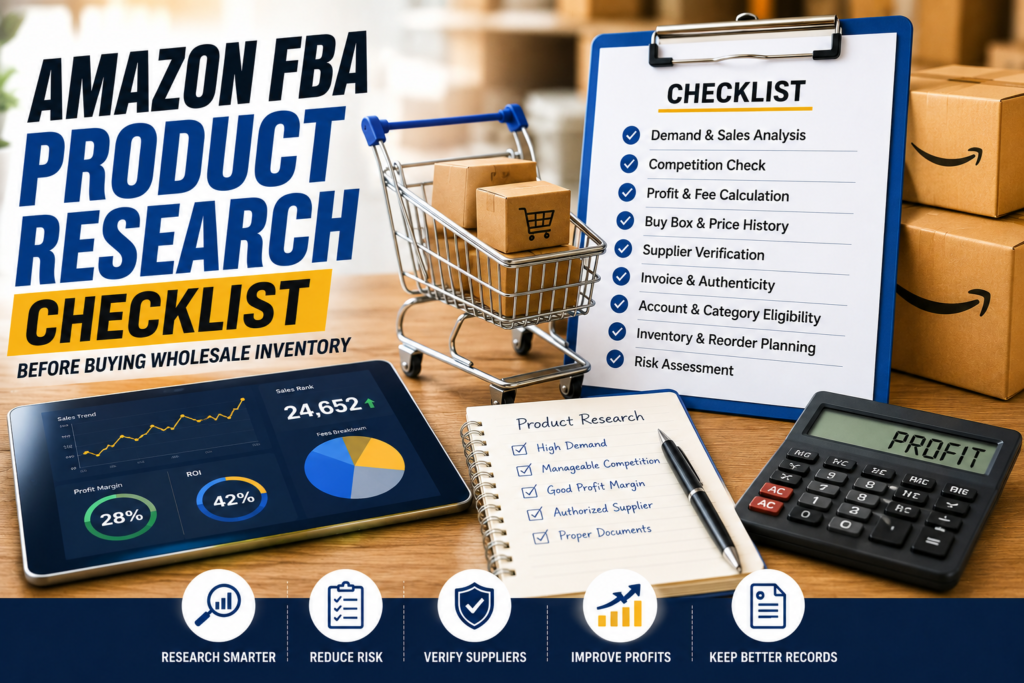
That is where a practical Amazon FBA product research checklist becomes useful.
A checklist helps you slow down before placing a purchase order and evaluate the product as a business decision rather than an exciting opportunity.
In our previous guides on Pet Supplies wholesale sourcing and Beauty & Personal Care wholesale sourcing, we discussed category-specific sourcing considerations. This guide brings those ideas together into a repeatable product research process you can use across multiple wholesale categories.
What should Amazon FBA sellers check before buying wholesale inventory?
Before purchasing inventory, check:
- Amazon selling eligibility
- Exact ASIN and product match
- Current and historical selling price
- Estimated demand
- Number and quality of competing sellers
- Amazon referral and FBA fees
- Net profit and ROI
- Supplier legitimacy
- Invoice quality
- Product authenticity
- Brand restrictions
- Storage and expiration risks
- Minimum order quantity
- Reorder availability
A product should not be purchased simply because it has a strong sales rank or attractive margin.
The strongest wholesale opportunities combine reasonable demand, stable pricing, manageable competition, authentic sourcing, suitable documentation, and acceptable profitability.
What Is Amazon FBA Wholesale Product Research?
Amazon FBA wholesale product research is the process of evaluating a product before buying it from a supplier for resale on Amazon.
Wholesale sellers are usually not creating a new listing from scratch. Instead, they often source existing branded products and sell against an established ASIN.
That creates a different research process from private label.
You need to study the existing listing, other sellers, Buy Box conditions, price movement, supplier documentation, and whether the exact product offered by your distributor matches the Amazon listing.
A good research process answers four basic questions:
- Can I sell this product?
- Will customers actually buy it?
- Can I source it safely and repeatedly?
- Will I still make enough money after all costs?
If any of those answers are unclear, more research is needed before you order inventory.
Why Product Research Matters for Amazon FBA Sellers
Wholesale buying magnifies both good and bad decisions.
If you make a $2 mistake on one unit, it may not seem serious.
If you buy 500 units, that same mistake becomes $1,000.
Product research matters because it can help you identify issues before your capital is tied up in inventory.
It Helps Protect Your Cash Flow
Wholesale suppliers may have minimum order quantities or case-pack requirements.
Once an order is placed, your money is committed.
Careful research helps you avoid putting too much capital into products that may sell slowly or experience price drops.
It Helps Reduce Listing Problems
A wholesale product must match the Amazon ASIN correctly.
Different sizes, formulas, colors, pack counts, regional versions, or packaging updates can create listing problems if you assume they are identical.
It Supports Better Sourcing Records
Amazon may request sourcing documentation in certain situations involving product authenticity, eligibility, or account health.
Amazon representatives have stated in Seller Central forums that invoices can be requested to establish authenticity and product source, and that documents should contain supplier, buyer, quantity, and other relevant information.
That makes supplier quality part of product research—not something to check after you buy.
Step-by-Step Amazon FBA Product Research Checklist
Use the following process before approving any wholesale purchase.
Step 1: Confirm You Are Eligible to Sell the Product
This should happen before profitability research.
Open the ASIN inside Seller Central and confirm whether your account is eligible to sell it.
Some products, categories, or brands may require approval.
Requirements may vary based on:
- Seller account
- Category
- Brand
- ASIN
- Marketplace
- Product condition
Do not assume that because another seller can list the product, you can too.
A profitable product is useless to you if your account cannot list it.
Step 2: Confirm the Exact ASIN Match
Never match products by brand name alone.
Check:
- UPC or EAN
- Pack count
- Product size
- Model number
- Color
- Formula
- Packaging
- Quantity
- Variant
- Regional version
For example, a 12-pack and 24-pack may appear very similar but belong to completely different Amazon listings.
Beauty, grocery, supplements, pet products, and household goods require extra attention because packaging or formulas can change over time.
EN Distributions’ current category guidance also emphasizes verifying the exact ASIN and product condition before purchasing inventory.
Step 3: Check Current Selling Price
Record the current Buy Box price, but do not base your decision on one moment in time.
Ask:
- Is the price normal?
- Has it recently increased?
- Does it regularly fall?
- Are sellers aggressively undercutting each other?
- Is Amazon itself competing on the listing?
A product selling for $29 today may spend most of the year around $22.
Your profitability calculation should use a realistic price, not the highest price you can find.
AI Snippet Answer: Should I Use the Current Buy Box Price?
Use the current Buy Box as one data point, not your entire forecast. Wholesale sellers should review historical price behavior and calculate profitability at multiple selling prices before buying inventory.
Step 4: Estimate Real Demand
Sales rank can be useful, but no single metric should make the buying decision.
Review:
- Sales rank
- Rank consistency
- Estimated monthly sales
- Listing history
- Review activity
- Seasonal patterns
- Category demand
- Number of sellers sharing those sales
A product may sell 1,000 units per month, but that does not mean you will sell 1,000 units.
If 20 established sellers compete on the listing, your share may be much smaller.
Step 5: Analyse the Competition
Seller count matters, but seller quality matters even more.
Look at:
- Number of FBA sellers
- FBM sellers
- Amazon Retail presence
- Brand-owner presence
- Seller feedback
- Stock levels where visible
- Buy Box rotation
- Price behaviour
A listing with three stable sellers can sometimes be healthier than one with 25 sellers constantly lowering their prices.
You are looking for manageable competition, not necessarily zero competition.
Step 6: Calculate All Amazon and Operational Fees
Do not calculate profit as:
Selling Price − Wholesale Cost = Profit
Your real costs may include:
- Wholesale cost
- Amazon referral fee
- FBA fulfillment fee
- Inbound shipping
- Inbound placement-related costs
- Prep center charges
- Labeling
- Storage
- Returns
- Removal expenses
- Software costs
- Other operating expenses
For example:
Selling price: $30.00
Wholesale cost: $14.00
Amazon + FBA fees: $8.00
Shipping and prep: $1.50
Estimated profit:
$30 − $14 − $8 − $1.50 = $6.50
That is the number that matters.
Step 7: Calculate ROI and Margin
Two useful wholesale metrics are ROI and profit margin.
ROI Formula
ROI = Net Profit ÷ Product Investment × 100
Margin Formula
Profit Margin = Net Profit ÷ Selling Price × 100
Do not chase a specific ROI percentage blindly.
A lower-margin product with strong repeat demand and stable pricing may sometimes be more attractive than a high-margin product with unpredictable sales.
Step 8: Stress-Test the Selling Price
Before buying, calculate your numbers at:
- Current price
- 5% lower price
- 10% lower price
- Your estimated break-even price
This answers an important question:
How much room do I have if competition increases?
If the product becomes unprofitable after a small price drop, the opportunity may be too fragile.
Step 9: Verify the Wholesale Supplier
Supplier verification should be part of product research.
Before ordering, check whether the business has:
- Registered business information
- Professional contact details
- Business email
- Wholesale policies
- Clear pricing
- Commercial invoices
- Product information
- Traceable sourcing
- Reasonable payment methods
EN Distributions explains that sellers should review supplier details, invoice quality, product authenticity, and documentation rather than relying on unrealistic supplier promises.
You can learn more about the company and its sourcing approach on the EN Distributions About Us page.
Step 10: Review Invoice Quality Before Ordering
Do not wait until Amazon requests documents to discover that your supplier’s invoice is incomplete.
A commercial wholesale invoice should generally contain clear business information such as:
- Supplier name
- Supplier contact information
- Buyer business details
- Invoice date
- Product names
- Quantities
- Pricing
- Invoice number where applicable
Amazon may request invoices or related information in authenticity or selling-approval situations, although the exact documentation requirements can vary.
Proper invoices may help support approval or authenticity requests depending on Amazon’s requirements, but they do not guarantee approval.
Step 11: Check Product Authenticity and Condition Risk
Your product must be authentic and delivered in the condition expected by Amazon customers.
Check:
- Seals
- Packaging
- Expiration dates
- Lot codes where applicable
- Product labels
- Damage risk
- Leakage risk
- Fragility
- Temperature sensitivity
- Shelf life
Products in Beauty, Grocery, Pet, Health, and similar categories often require more careful condition checks.
The current EN Distributions wholesale category guidance highlights authenticity, sealed condition, labeling, expiry, and accurate ASIN matching as important considerations.
Step 12: Check Minimum Order Quantity
A profitable ASIN may still be a poor deal if the supplier requires too much inventory.
Suppose your research suggests you can reasonably sell 30 units per month.
A supplier requiring 300 units means potentially carrying around ten months of inventory before considering competition or demand changes.
Ask:
- What is the MOQ?
- Is it per product or total order?
- Can I test a smaller quantity?
- How quickly can I reorder?
Controlled test orders can help reduce unnecessary inventory exposure.
Step 13: Check Reorder Potential
Wholesale works best when profitable products can be replenished.
Ask your supplier:
- Is this product regularly stocked?
- What is the typical lead time?
- Does pricing change with quantity?
- How frequently can I reorder?
- Is the product seasonal?
- Is it being discontinued?
A product that works once can generate a profit.
A product that can be repeatedly sourced may become part of a more reliable wholesale system.
That connects directly with our previous guide on building a repeatable wholesale growth strategy for Amazon FBA.
Common Product Research Mistakes to Avoid
Buying Before Checking Restrictions
Always verify your selling eligibility first.
Focusing Only on Sales Rank
Strong demand does not automatically mean strong profit.
Competition, fees, Buy Box share, and sourcing cost still matter.
Ignoring Amazon as a Seller
If Amazon Retail is consistently controlling the listing, evaluate the opportunity very carefully.
Trusting One-Day Pricing
A temporary price increase can make a poor product look attractive.
Buying Too Much Inventory
Do not let a lower unit cost convince you to purchase more inventory than the market can reasonably absorb.
Ignoring Supplier Documents
Your supplier is part of your Amazon risk profile.
Cheap inventory from an unclear source can create much larger problems later.
Assuming an Invoice Guarantees Approval
It does not.
Wholesale invoices may help support approval requests, depending on Amazon’s requirements, but Amazon makes its own decisions.
How a Verified Wholesale Distributor Can Help
A professional wholesale distributor can help sellers build a more structured sourcing process.
EN Distributions provides wholesale sourcing services for ecommerce sellers looking for access to branded inventory and commercial purchasing documentation.
You can review available wholesale sourcing services to better understand how the distribution process works.
Working with an established distributor can help sellers:
- Maintain clearer sourcing records
- Receive commercial invoices
- Access wholesale product categories
- Communicate directly with a business supplier
- Track purchase history
- Plan replenishment
- Verify product information before ordering
This does not remove the seller’s responsibility to perform product research.
A distributor can provide sourcing support, but you still need to check demand, competition, Amazon eligibility, fees, and profitability before purchasing inventory.
To explore current wholesale opportunities, visit EN Distributions.
Final Thoughts
A strong Amazon FBA wholesale seller does not ask only:
“Will this product sell?”
The better question is:
“Is this product profitable, sellable from my account, competitively positioned, authentically sourced, properly documented, and realistically replenishable?”
Before buying any wholesale product, use this checklist:
- Confirm selling eligibility
- Match the exact ASIN
- Review demand
- Check historical pricing
- Analyse competitors
- Calculate all fees
- Calculate ROI and margin
- Stress-test lower prices
- Verify the supplier
- Review invoices
- Confirm authenticity
- Check MOQ
- Evaluate inventory risk
- Confirm reorder potential
Following a repeatable process can help sellers make more disciplined inventory decisions and maintain better sourcing records as their business grows.
Ready to explore wholesale sourcing opportunities?
Apply for a wholesale account with EN Distributions to submit your business information and review potential wholesale opportunities.
If you have questions about product sourcing, invoices, available categories, or distributor verification, contact EN Distributions before placing your order.
Requirements may vary by category, marketplace, brand, ASIN, and Amazon seller account.
FAQs
1. What should I check before buying wholesale inventory for Amazon FBA?
Check selling eligibility, exact ASIN match, demand, pricing history, competition, Amazon fees, ROI, supplier legitimacy, invoice quality, authenticity, MOQ, and reorder availability before purchasing.
2. How do I know if a wholesale product is profitable on Amazon?
Subtract wholesale cost, Amazon referral fees, FBA fees, inbound shipping, prep, storage, and other operating costs from the expected selling price. Then calculate net profit, ROI, and margin.
3. Should I buy a product just because it has a low BSR?
No. A low sales rank may indicate demand, but you should also evaluate seller competition, pricing history, Amazon fees, Buy Box conditions, supplier cost, and your own selling eligibility.
4. Can a wholesale invoice help with Amazon ungating?
A legitimate wholesale invoice may help support an approval or ungating request depending on Amazon’s requirements. It does not guarantee approval, and requirements may vary by category, brand, marketplace, and seller account.
5. Why should I verify a wholesale distributor before ordering?
Distributor verification helps reduce the risk of unclear sourcing, poor documentation, counterfeit products, and unreliable supply. Sellers should check business details, invoices, product authenticity, contact information, and supplier policies before ordering.
One Response