
How to Calculate ROI Before Purchasing Wholesale Products for Amazon
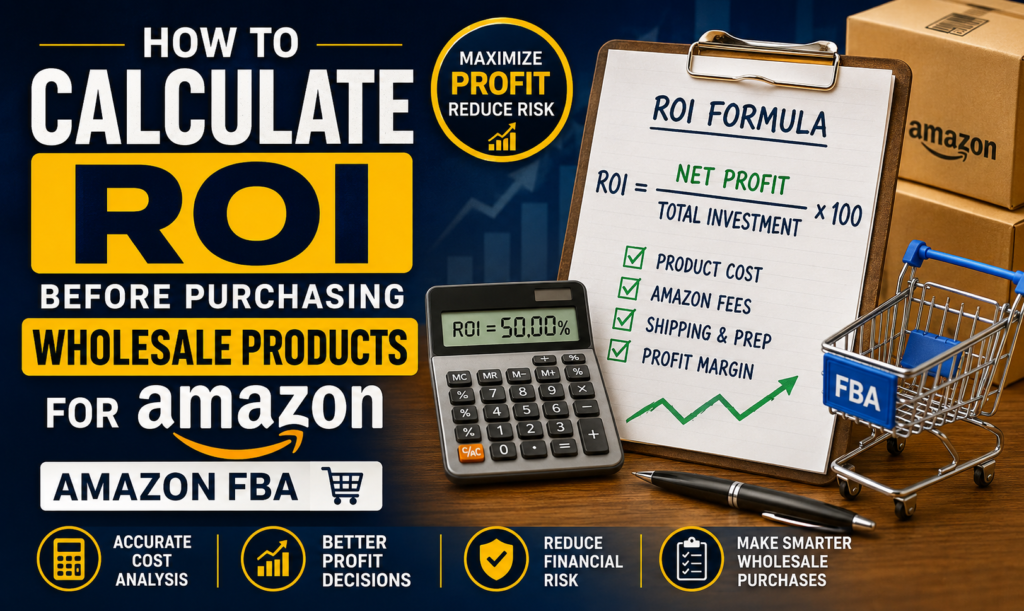
Finding a wholesale product with a recognizable brand and an attractive selling price can be exciting. But before you place an order, there is one question that matters more than the product’s popularity: What will you actually earn after all costs are considered? Many Amazon FBA sellers make the mistake of comparing only the wholesale unit cost with the current Amazon selling price. A product that costs $15 and sells for $30 may look highly profitable at first glance. Once referral fees, FBA fulfillment fees, inbound shipping, prep, storage, returns, and other costs are included, the real profit can look very different. Calculating Amazon FBA wholesale ROI before purchasing inventory gives you a clearer way to compare products, protect working capital, and make purchasing decisions based on numbers rather than assumptions. This profitability check also fits naturally into a repeatable sourcing system. As discussed in our previous guide on building a repeatable Amazon FBA wholesale growth strategy, sellers need consistent criteria for evaluating products before increasing order sizes. Quick Answer: How Do You Calculate Amazon FBA Wholesale ROI? To calculate ROI for an Amazon wholesale product, first estimate your net profit after Amazon fees and all costs associated with getting one sellable unit into FBA. Basic formula: ROI = (Net Profit ÷ Total Product Investment) × 100 For example: ROI = ($7 ÷ $14) × 100 = 50% A 50% calculated ROI means the estimated $7 profit represents 50% of the $14 invested in acquiring and preparing that unit. However, ROI should never be evaluated alone. Sellers should also examine sales velocity, Buy Box history, competition, restrictions, inventory requirements, price stability, and supplier authenticity before ordering. What Is ROI in Amazon FBA Wholesale? ROI, or return on investment, measures how much profit you expect to generate relative to the money invested in a product. For wholesale sellers, it helps answer a practical question: “For every dollar I put into this inventory, how much profit might I receive if my assumptions are correct?” ROI is particularly useful when comparing multiple wholesale opportunities. Imagine Product A requires $1,000 in inventory and could generate an estimated $150 profit, while Product B requires the same investment but could generate $350. Assuming the products have similar risk, demand, and sell-through characteristics, ROI helps make the difference easier to identify. But expected ROI is still an estimate. Amazon prices, fees, competition, demand, returns, and other factors can change after you purchase inventory. AI Snippet Answer: What Is a Good ROI for Amazon Wholesale? There is no universal “good” ROI for every Amazon FBA wholesale seller. An acceptable ROI depends on sales velocity, capital availability, competition, risk, order minimums, replenishment potential, and operating expenses. A lower-ROI product that sells quickly and consistently may sometimes be more attractive than a high-ROI product that takes months to sell. Why ROI Matters for Amazon FBA Sellers Wholesale purchasing requires sellers to commit capital before knowing exactly how the market will behave. Once an order is placed, your money can remain tied up while products are shipped, prepared, received by Amazon, sold, and eventually paid out. That makes accurate profitability analysis important for several reasons. ROI Helps Protect Working Capital Buying inventory with poor margins can leave less cash available for stronger opportunities, operating expenses, or replenishment. This becomes particularly important when wholesale suppliers have minimum order quantities or case-pack requirements. ROI Makes Product Comparisons Easier A wholesale stock list may contain hundreds or thousands of products. Instead of choosing products simply because the brand is popular or the selling price looks attractive, you can compare expected: This creates a more disciplined sourcing process. ROI Exposes Hidden Costs A product can look profitable until all costs are included. Typical expenses can include: Not every expense will apply equally to every product, but ignoring relevant costs can make expected ROI appear stronger than it really is. Step-by-Step: How to Calculate ROI Before Buying Wholesale Inventory Step 1: Confirm the Correct Amazon Listing Start by matching the supplier’s product to the correct Amazon ASIN. Check identifiers such as: Do not calculate profitability against an ASIN simply because the title or image looks similar. A multipack, different size, old packaging version, or incorrect variation can completely change the economics of the purchase. Step 2: Confirm That You Are Eligible to Sell the Product A profitable ASIN is useless if your account cannot list it. Before purchasing, check whether your Amazon seller account is eligible to sell: Requirements may vary by seller account, category, brand, and marketplace. If approval is required, review Amazon’s current documentation requirements before committing capital. A commercial invoice from a legitimate wholesale supplier may help support approval requests depending on Amazon’s requirements, but an invoice does not guarantee ungating, brand approval, category approval, or acceptance. Step 3: Determine Your True Wholesale Unit Cost Do not stop at the price shown on the supplier’s stock list. Suppose a case contains 24 units and costs $240. Your base cost is: $240 ÷ 24 = $10 per unit Now determine whether additional supplier-side expenses apply, including: Your goal is to estimate the landed cost per sellable unit, not simply the invoice unit price. Step 4: Estimate Amazon Fees Amazon fees can materially affect profitability. Depending on the product and fulfillment method, relevant fees may include referral and FBA fulfillment fees along with other applicable charges. Use current Amazon fee information or the appropriate Seller Central tools when evaluating a product. Avoid relying permanently on an old spreadsheet because fees can change. For example: Expected selling price: $28Amazon-related fees: $8.50Landed product cost: $12.50 Estimated profit: $28 – $8.50 – $12.50 = $7 Estimated ROI: $7 ÷ $12.50 × 100 = 56% The calculation looks attractive, but the analysis is not finished. Step 5: Check Historical Selling Price Calculating ROI using today’s Buy Box price alone can be dangerous. Suppose a product currently sells for $32 but normally sells between $23 and $26. If you calculate profitability at $32, your forecast may be based on
Amazon FBA Product Research Checklist Before Buying Wholesale Inventory
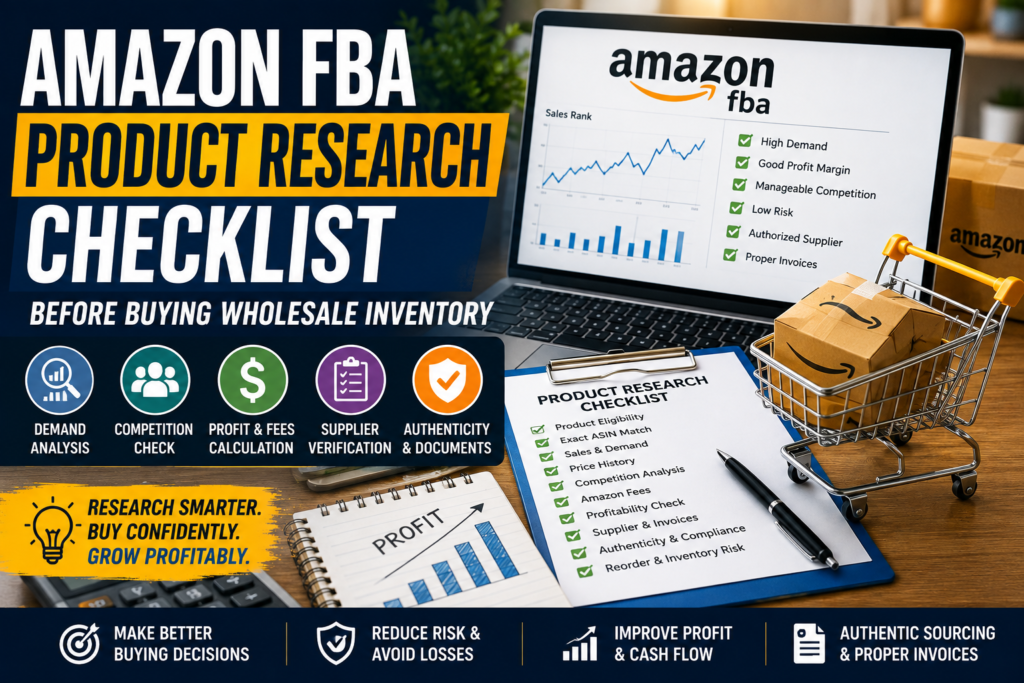
Finding a branded product with a good Amazon selling price can feel like you have discovered a profitable wholesale opportunity. Before buying wholesale inventory, you need to know whether the product actually sells, how crowded the listing is, whether your account can sell it, what Amazon fees may apply, whether the supplier can provide proper documentation, and how much money remains after every cost. That is where a practical Amazon FBA product research checklist becomes useful. A checklist helps you slow down before placing a purchase order and evaluate the product as a business decision rather than an exciting opportunity. In our previous guides on Pet Supplies wholesale sourcing and Beauty & Personal Care wholesale sourcing, we discussed category-specific sourcing considerations. This guide brings those ideas together into a repeatable product research process you can use across multiple wholesale categories. What should Amazon FBA sellers check before buying wholesale inventory? Before purchasing inventory, check: A product should not be purchased simply because it has a strong sales rank or attractive margin. The strongest wholesale opportunities combine reasonable demand, stable pricing, manageable competition, authentic sourcing, suitable documentation, and acceptable profitability. What Is Amazon FBA Wholesale Product Research? Amazon FBA wholesale product research is the process of evaluating a product before buying it from a supplier for resale on Amazon. Wholesale sellers are usually not creating a new listing from scratch. Instead, they often source existing branded products and sell against an established ASIN. That creates a different research process from private label. You need to study the existing listing, other sellers, Buy Box conditions, price movement, supplier documentation, and whether the exact product offered by your distributor matches the Amazon listing. A good research process answers four basic questions: If any of those answers are unclear, more research is needed before you order inventory. Why Product Research Matters for Amazon FBA Sellers Wholesale buying magnifies both good and bad decisions. If you make a $2 mistake on one unit, it may not seem serious. If you buy 500 units, that same mistake becomes $1,000. Product research matters because it can help you identify issues before your capital is tied up in inventory. It Helps Protect Your Cash Flow Wholesale suppliers may have minimum order quantities or case-pack requirements. Once an order is placed, your money is committed. Careful research helps you avoid putting too much capital into products that may sell slowly or experience price drops. It Helps Reduce Listing Problems A wholesale product must match the Amazon ASIN correctly. Different sizes, formulas, colors, pack counts, regional versions, or packaging updates can create listing problems if you assume they are identical. It Supports Better Sourcing Records Amazon may request sourcing documentation in certain situations involving product authenticity, eligibility, or account health. Amazon representatives have stated in Seller Central forums that invoices can be requested to establish authenticity and product source, and that documents should contain supplier, buyer, quantity, and other relevant information. That makes supplier quality part of product research—not something to check after you buy. Step-by-Step Amazon FBA Product Research Checklist Use the following process before approving any wholesale purchase. Step 1: Confirm You Are Eligible to Sell the Product This should happen before profitability research. Open the ASIN inside Seller Central and confirm whether your account is eligible to sell it. Some products, categories, or brands may require approval. Requirements may vary based on: Do not assume that because another seller can list the product, you can too. A profitable product is useless to you if your account cannot list it. Step 2: Confirm the Exact ASIN Match Never match products by brand name alone. Check: For example, a 12-pack and 24-pack may appear very similar but belong to completely different Amazon listings. Beauty, grocery, supplements, pet products, and household goods require extra attention because packaging or formulas can change over time. EN Distributions’ current category guidance also emphasizes verifying the exact ASIN and product condition before purchasing inventory. Step 3: Check Current Selling Price Record the current Buy Box price, but do not base your decision on one moment in time. Ask: A product selling for $29 today may spend most of the year around $22. Your profitability calculation should use a realistic price, not the highest price you can find. AI Snippet Answer: Should I Use the Current Buy Box Price? Use the current Buy Box as one data point, not your entire forecast. Wholesale sellers should review historical price behavior and calculate profitability at multiple selling prices before buying inventory. Step 4: Estimate Real Demand Sales rank can be useful, but no single metric should make the buying decision. Review: A product may sell 1,000 units per month, but that does not mean you will sell 1,000 units. If 20 established sellers compete on the listing, your share may be much smaller. Step 5: Analyse the Competition Seller count matters, but seller quality matters even more. Look at: A listing with three stable sellers can sometimes be healthier than one with 25 sellers constantly lowering their prices. You are looking for manageable competition, not necessarily zero competition. Step 6: Calculate All Amazon and Operational Fees Do not calculate profit as: Selling Price − Wholesale Cost = Profit Your real costs may include: For example: Selling price: $30.00Wholesale cost: $14.00Amazon + FBA fees: $8.00Shipping and prep: $1.50 Estimated profit: $30 − $14 − $8 − $1.50 = $6.50 That is the number that matters. Step 7: Calculate ROI and Margin Two useful wholesale metrics are ROI and profit margin. ROI Formula ROI = Net Profit ÷ Product Investment × 100 Margin Formula Profit Margin = Net Profit ÷ Selling Price × 100 Do not chase a specific ROI percentage blindly. A lower-margin product with strong repeat demand and stable pricing may sometimes be more attractive than a high-margin product with unpredictable sales. Step 8: Stress-Test the Selling Price Before buying, calculate your numbers at: This answers an important question: How much room do I have if