
A product can look profitable when you first compare the wholesale price with its Amazon selling price. But once the order is placed, the real numbers often begin to change.
Amazon referral fees, FBA fulfillment fees, prep costs, storage charges, inbound shipping, returns, and slow-moving inventory can all reduce the profit you expected to make. These costs do not always appear in one place, which is why many new wholesale sellers feel surprised when a “good” product produces only a small return—or no meaningful profit at all.
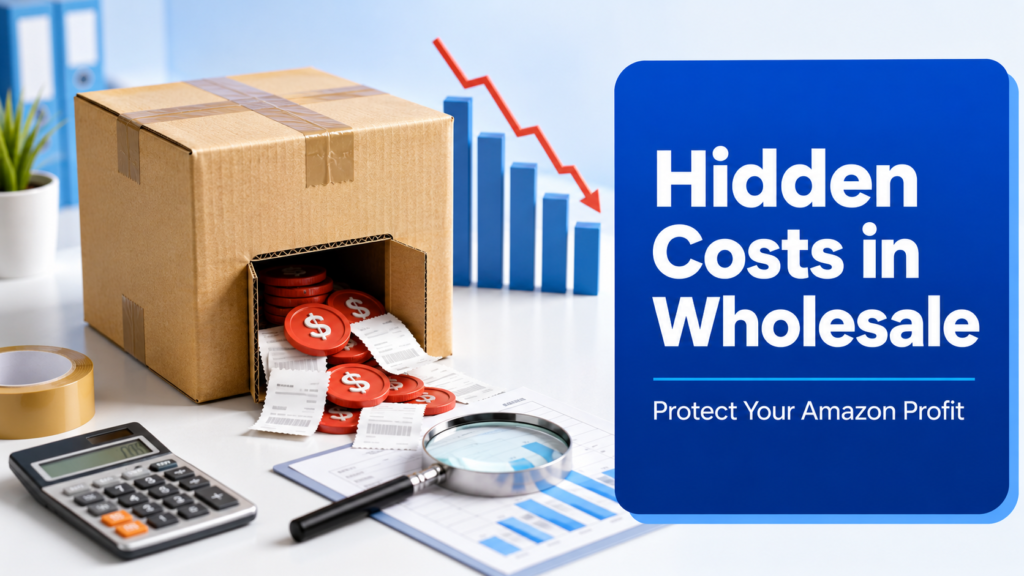
The good news is that most of these costs can be planned for. You do not need to predict every possible expense perfectly. You simply need a consistent process for calculating your true landed cost before you place a wholesale order.
This guide explains the hidden costs in Amazon wholesale and how to account for them before they affect your margins.
Quick Answer
Hidden costs in Amazon wholesale often include Amazon referral and FBA fees, inbound shipping, prep and labeling, storage, returns, price changes, damaged inventory, and the cost of money tied up in slow-selling products.
To protect profit, calculate your total landed cost per unit—not just the supplier price. Your landed cost should include the product cost, shipping, prep, labels, taxes where applicable, and a realistic allowance for returns or unexpected issues. Always review current fees in Seller Central because requirements may vary by category and marketplace.
What Are Hidden Costs in Amazon Wholesale?
Hidden costs are expenses that are easy to overlook when evaluating a wholesale product for Amazon FBA. They are not always “hidden” by Amazon or your supplier; rather, they may be missed because sellers focus mainly on purchase cost and selling price.
For example, a seller might buy a product for $12 and see it selling on Amazon for $28. At first glance, the deal seems attractive. But after subtracting Amazon fees, shipping to the fulfillment center, prep materials, returns, and price competition, the actual profit may be far lower.
A more realistic profit calculation looks like this:
Selling Price – Amazon Fees – Product Cost – Inbound Shipping – Prep Costs – Storage Allowance – Return Allowance = Estimated Net Profit
This does not mean every product needs a complicated spreadsheet. It means sellers should evaluate the complete cost of getting one sellable unit from a verified supplier into a customer’s hands.
Why Hidden Costs Matter for Amazon FBA Sellers
Wholesale is often built on repeatability. You find products that meet your criteria, place orders, send inventory to Amazon, monitor performance, and reorder when the numbers continue to make sense.
If your calculations ignore important costs, you may reorder products that are not truly profitable. Over time, this can affect cash flow and make it harder to invest in better opportunities.
Understanding your real costs can help you:
- Set more realistic profit expectations
- Compare multiple products more accurately
- Avoid buying too much slow-moving inventory
- Decide whether FBA or another fulfillment method makes sense
- Plan reorder budgets with greater confidence
- Protect account health by sourcing carefully and maintaining records
This connects directly with inventory planning. If you have read our articles about how often Amazon sellers should reorder wholesale inventory, inventory forecasting for Amazon wholesale sellers, or seasonal inventory planning, you already know that timing matters. However, the amount you reorder should also reflect the full cost of carrying that inventory.
Step-by-Step Guide to Finding Your True Amazon Wholesale Cost
1. Start With the Wholesale Product Cost
The first number is the supplier’s unit price. This may include case pricing, minimum order quantities, quantity discounts, or shipping terms that affect the final amount you pay.
Do not only look at the lowest advertised unit cost. Ask practical questions:
- Is there a minimum quantity required?
- Is freight included or charged separately?
- Are there payment processing fees?
- Is there a discount for ordering by case or pallet?
- Are you buying products that are likely to sell at a stable price?
A low purchase price is helpful, but it does not automatically create a profitable Amazon listing.
2. Add Amazon Referral and FBA Fulfillment Fees
Amazon generally charges a referral fee when an item sells. For FBA products, there is also a fulfillment fee that covers services such as picking, packing, shipping, customer service, and returns processing.
Fees can depend on the product category, selling price, size tier, and shipping weight. This is why sellers should check the current fee estimate in Seller Central or Amazon’s revenue calculator before purchasing inventory.
Do not rely on an old calculation from a similar product. Small differences in dimensions or weight can change the expected FBA fee.
3. Include Inbound Shipping to Amazon
Inbound shipping is the cost of moving inventory from your supplier, warehouse, prep center, or office to Amazon’s assigned fulfillment center.
This cost may include:
- Shipping from the distributor to your location
- Freight charges for larger orders
- Shipping from your location to a prep center
- Carrier charges to Amazon FBA
- Fuel, delivery, or residential pickup surcharges
- Packaging materials for cartons
For smaller orders, inbound shipping per unit can be much higher than expected. Divide the total shipping expense by the number of units shipped to understand its real effect on each product.
4. Account for Prep, Labels, and Packaging
Amazon FBA preparation costs are usually manageable per unit, but they add up when you handle many products. Some inventory may only need a label, while other products need poly bags, bubble wrap, seal stickers, multipack labels, or special handling.
Your prep cost may include:
- FNSKU labels
- Thermal printer labels and ink
- Poly bags and warning labels
- Bubble wrap, tape, and protective materials
- Labor time for inspection and packing
- Third-party prep center fees, if used
Even if you prepare inventory yourself, your time has value. You do not need to assign a high labor cost to every unit, but it is useful to track how long larger shipments take. This helps you decide whether self-prep remains efficient as your wholesale business grows.
5. Consider Storage and Inventory-Age Risk
FBA storage fees are a normal part of selling through Amazon, but slow-moving inventory can become expensive. Products that remain in fulfillment centers for longer periods may affect your cash flow and create additional charges depending on Amazon’s current policies.
Storage risk is especially important when:
- You order more units than demand supports
- A competitor lowers the price
- Seasonal demand ends earlier than expected
- The listing loses momentum or visibility
- A brand changes its distribution strategy
- A product becomes restricted or unavailable for sale
This is why forecasting should be based on actual sales data, not only on a single strong month. A product that sells consistently at a moderate pace can sometimes be safer than a product with a high sales rank but unstable pricing.
6. Build in a Return and Damage Allowance
Not every unit you send to Amazon will create a perfect sale. Customers may return products, items may arrive damaged, or inventory may become unsellable.
You cannot always know the exact return rate in advance, but you can include a modest allowance in your calculations. This is particularly important for fragile goods, products with packaging that can be easily opened, and categories where customer expectations are high.
Track these issues over time:
- Customer returns
- Damaged inventory
- Unsellable units
- Reimbursement cases
- Disposal or removal costs
- Negative feedback connected to product condition
The purpose is not to assume the worst. It is to avoid treating every purchased unit as if it will sell at full price without any issue.
7. Watch for Price Drops and Buy Box Changes
A product’s selling price can change after you place an order. This is one of the most common reasons expected profits shrink.
Before buying, review more than the current listing price. Look at price history, seller count, stock levels, sales consistency, and whether the brand or Amazon itself is competing on the listing.
Ask yourself:
- Is the Buy Box price stable?
- Are several sellers entering the listing?
- Is Amazon a seller on the listing?
- Can my margin survive a modest price reduction?
- Is the product still worth buying if I need to price slightly lower?
A product with a good profit margin at one price may become unworkable after a small drop. Building a margin buffer helps you make stronger sourcing decisions.
8. Include Taxes, Currency, and Payment Costs Where Relevant
Depending on where you operate and where you source products, you may have taxes, import-related charges, currency conversion costs, wire fees, or card processing charges.
These costs vary significantly by business and marketplace, so they should be reviewed with the right financial or tax professional where needed. However, sellers should still record them as part of the purchase cost when they affect a specific order.
If an expense is connected to buying or delivering inventory, it belongs in your profit calculation.
Common Hidden Costs to Watch in Amazon Wholesale
Here is a simple checklist to use before placing an order:
- Wholesale unit price
- Distributor freight or delivery charge
- Amazon referral fee
- FBA fulfillment fee
- Inbound shipping to Amazon
- Prep and labeling materials
- Prep center labor or handling charges
- Storage fees and long-term inventory risk
- Returns, damage, and unsellable inventory
- Removal or disposal fees
- Taxes, payment fees, and currency conversion
- Price-drop risk and Buy Box competition
You may not need to include every cost for every product. But reviewing this list prevents you from leaving out the expenses that matter most.
Common Mistakes to Avoid
Looking Only at the Current Selling Price
The current price is only one part of the decision. Check whether the listing price has been stable enough to support your estimated margin.
Treating Supplier Cost as Total Cost
The supplier invoice is the starting point—not the final profitability figure. Shipping, prep, Amazon fees, and inventory risk must be considered.
Ordering Large Quantities Before Testing
A larger order can lower the unit cost, but it also increases your exposure if demand slows down. New products or new supplier relationships may be better tested with a manageable quantity first.
Ignoring Product Size and Weight
FBA fees and shipping costs are strongly affected by size and weight. A product that is slightly oversized or heavy can have a much lower margin than a smaller alternative.
Keeping No Record of Actual Costs
If you do not compare your estimates with real shipment costs, you cannot improve your sourcing process. Keep a simple tracker for product cost, prep, shipping, selling price, fees, and actual net profit.
How a Verified Wholesale Distributor Can Help
A reliable wholesale distributor can help sellers create a more organized sourcing process. Clear invoices, accurate product information, legitimate supply records, and consistent communication all support better decision-making.
For Amazon sellers, proper invoices and traceable purchasing records may help support approval requests, depending on Amazon’s requirements. They can also help sellers keep better sourcing records and understand the origin of their inventory.
At EN Distributions, sellers can learn more about the company’s sourcing approach and explore wholesale opportunities. Reviewing available services may also help you understand how support for wholesale sourcing, documentation, product authenticity, and account-related needs fits into your business process.
Before placing a large order, ask the distributor for the details you need to evaluate your margin properly, including product pricing, quantities, shipping terms, and invoice information. Requirements may vary by category and marketplace, so always confirm Amazon’s latest standards before you buy.
Final Thoughts
Profit in Amazon wholesale is not only about finding products with a large gap between cost and selling price. It is about understanding the complete journey of each unit—from supplier invoice to Amazon fulfillment and customer delivery.
The best approach is simple: calculate your true landed cost, leave room for changing prices and unexpected expenses, and use your past shipment data to improve future buying decisions. Small improvements in cost tracking can make a meaningful difference across repeated wholesale orders.
If you are looking for authentic wholesale products and clearer sourcing records, you can apply for a wholesale account with EN Distributions. To discuss product categories, sourcing needs, or the next steps for your Amazon wholesale business, contact the team.
FAQs
1. What are the biggest hidden costs in Amazon wholesale?
The most common hidden costs are Amazon referral and FBA fulfillment fees, inbound shipping, prep and labeling, storage, returns, damaged inventory, payment fees, and price drops after you purchase stock.
2. How do I calculate true profit for an Amazon wholesale product?
Subtract all costs from the expected selling price. Include the wholesale product cost, Amazon fees, inbound shipping, prep expenses, storage allowance, and a reasonable allowance for returns or damages.
3. Are FBA prep costs included in Amazon fees?
Not always. Amazon’s FBA fulfillment fee covers fulfillment services, but sellers may still need to pay for labels, packaging materials, prep services, or Amazon prep services where applicable.
4. Why can a profitable Amazon product become unprofitable later?
A product can become less profitable if the selling price falls, fees change, shipping costs increase, storage builds up, more sellers join the listing, or returns and damaged inventory increase.
5. Can wholesale invoices help with Amazon approval requests?
Proper invoices from legitimate suppliers may help support approval requests, depending on Amazon’s requirements. Requirements may vary by category, brand, product, and marketplace, so no approval outcome can be assumed.
2 Responses