
The online marketplace is more crowded and competitive than ever. For e-commerce brands, selling across multiple platforms like Amazon, Walmart, and independent storefronts offers incredible reach. However, this massive scale comes with a major challenge: price war, value erosion, and loose distribution control.
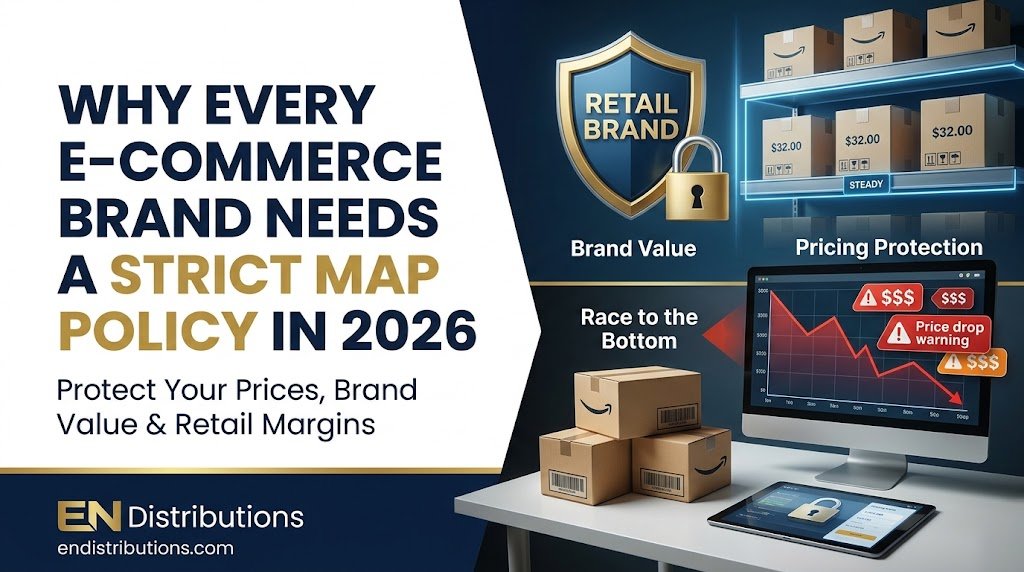
The single most effective defense against this chaos is a Minimum Advertised Price (MAP) policy. Modern online sales algorithms and aggressive pricing strategies mean a MAP policy is no longer just a “best practice”—it is a necessity for survival.
At EN Distributions, a leading Amazon FBA wholesale supplier in the USA, we understand that brand health is tied directly to price stability. We see firsthand how price battles can damage brand value. Here is why your brand needs a strict MAP policy and how to enforce it effectively.
What is a MAP Policy and Why Does It Matter?
A Minimum Advertised Price (MAP) policy is a formal agreement between a brand and its retail partners. It sets the lowest price at which a product can be advertised publicly. Crucially, it does not dictate the final checkout price (which can raise antitrust issues), but it strictly regulates the outward-facing price that consumers see on search pages, ads, and digital shelves.
A good MAP policy establishes a baseline that prevents sellers from aggressively undercutting each other to grab quick sales. It ensures that your product is valued for its quality, features, and reputation—not just because it happens to be the cheapest option available on a given day.
1. Stopping the Automated “Race to the Bottom”
The rise of automated repricing software has completely changed online retail. In the past, sellers checked competitor prices manually and adjusted their own once or twice a week. Today, artificial intelligence and automated repricers analyze the digital market and adjust prices in real time, often multiple times an hour.
Without a MAP policy, this automation triggers a fast “race to the bottom”:
- Seller A drops their price by $0.05 to win Amazon’s Buy Box.
- Seller B’s automated repricer instantly matches or undercuts that price.
- This loop repeats, and within hours, your $30 premium product is selling for $18, wiping out retail margins.
By implementing and enforcing a strict MAP policy, you establish a firm “floor” that repricing bots are not allowed to cross. This keeps your online prices stable and stops automated software from devaluing your brand.
2. Preserving Your Brand’s Value and Consumer Trust
Consumers often equate price with quality. If they see a product’s price constantly swinging wildly, it alters their perception of the brand.
If your premium product is advertised for $49.99 on your official website but consistently listed for $29.99 on Amazon, consumers will assume the lower price is its true value. If they buy it at full price and later find it heavily discounted elsewhere, they may feel cheated, which damages your relationship with them.
Maintaining a consistent, fair price across all platforms sends a strong message: our product is worth this investment. Over time, this stability builds customer trust and preserves your premium positioning.
3. Protecting Vital Brick-and-Mortar Retail Relationships
E-commerce is massive, but physical, brick-and-mortar stores remain a critical part of many brand strategies. These partners invest heavily in physical shelf space, local advertising, and hands-on customer service.
However, physical stores cannot compete with the incredibly low overhead of unauthorized online sellers. When e-commerce prices are allowed to crash, traditional retailers are heavily impacted. If store owners realize they cannot make a fair margin on your products because online sellers are constantly undercutting them, they will stop stocking your items and replace them with competitors who protect their pricing.
A strict MAP policy protects your traditional retail partners, ensuring they can safely carry and promote your products alongside your online channels.
4. Attracting Authorized, Professional Retailers
In 2026, the best Amazon and e-commerce sellers do not want to compete in a chaotic, race-to-the-bottom market. Professional, high-volume retailers are looking for brands that offer stability, consistent supply, and healthy margins.
When you enforce a strict MAP policy, you show top-tier retail partners that you take your business seriously. They know that if they buy inventory from an authorized distributor like EN Distributions and invest in marketing, their margins won’t be ruined by rogue sellers.
A strict policy helps you filter out fly-by-night sellers and attract dedicated, long-term partners who will actively invest in growing your brand. Learn more about our approach on our About Us page.
How to Successfully Implement and Enforce MAP
Simply writing a MAP policy is not enough; you have to actively enforce it. Use these key steps to establish and run a successful MAP program:
- Establish Clear, Unbiased Guidelines: Write a comprehensive MAP document that applies equally to all sellers—both online and offline. Clearly define what constitutes “advertising” (such as search results, email newsletters, and social media ads) and explain the exact consequences for violating the policy.
- Monitor the Marketplace: Use automated brand protection tools to track your prices across Amazon, Walmart, and the broader web. These platforms can instantly flag MAP violations, identify the offending sellers, and send automated alerts.
- Set Clear Consequences: Be consistent with your penalties. A standard enforcement path often includes a first warning, followed by a temporary supply suspension for a second offense, and permanent termination of the partnership for a third. Showing that you will act is essential for the policy’s credibility.
- Enforce Your Trademark and IP Rights: If unapproved sellers ignore your MAP policy, remember that you still have control over your intellectual property. You can utilize Amazon’s Brand Registry or issue cease-and-desist letters for unauthorized trademark use or copyright infringement.
Work with a Partner Who Respects Your Brand
The foundation of a successful MAP policy is a tightly controlled supply chain. If you sell to any distributor who asks, your inventory can easily find its way to unauthorized sellers who will ignore your pricing rules.
At EN Distributions, we provide FBA sellers and retailers with reliable, authorized sourcing while strictly respecting our brand partners’ guidelines.
- Verified Buyer Network: We only supply vetted retail businesses who go through our rigorous Apply for a Wholesale Account process. We verify their business credentials, Sales Tax Certificates, and sales channels to prevent inventory diversion.
- Comprehensive Logistics Support: Through our specialized Services, including careful handling and shipment coordination, we ensure your products arrive at FBA centers or retail stores in perfect condition. This reduces returns and listing issues that can lead to price drops.
- Partnership Focus: We believe in mutual growth. By maintaining price stability, we protect brand value while giving our retail clients a sustainable, profitable inventory source.
A strict MAP policy is the key to maintaining control over your brand, supporting your retail partners, and ensuring long-term profitability.
Ready to secure your brand’s presence in the marketplace? Contact EN Distributions today to learn how we can support your distribution and protect your brand’s equity. Or, check out our latest market insights on our News page.
One Response