
For many new Amazon FBA sellers, finding a profitable product feels like the hardest part. But once you start sourcing from wholesale suppliers, another important question quickly appears: “Will my invoice be accepted if Amazon asks for proof?”
That is where wholesale invoicing becomes important.
A proper wholesale invoice is not just a receipt. It is part of your sourcing record. It shows where your products came from, who supplied them, what you purchased, when you purchased them, and whether your supply chain looks professional and traceable.
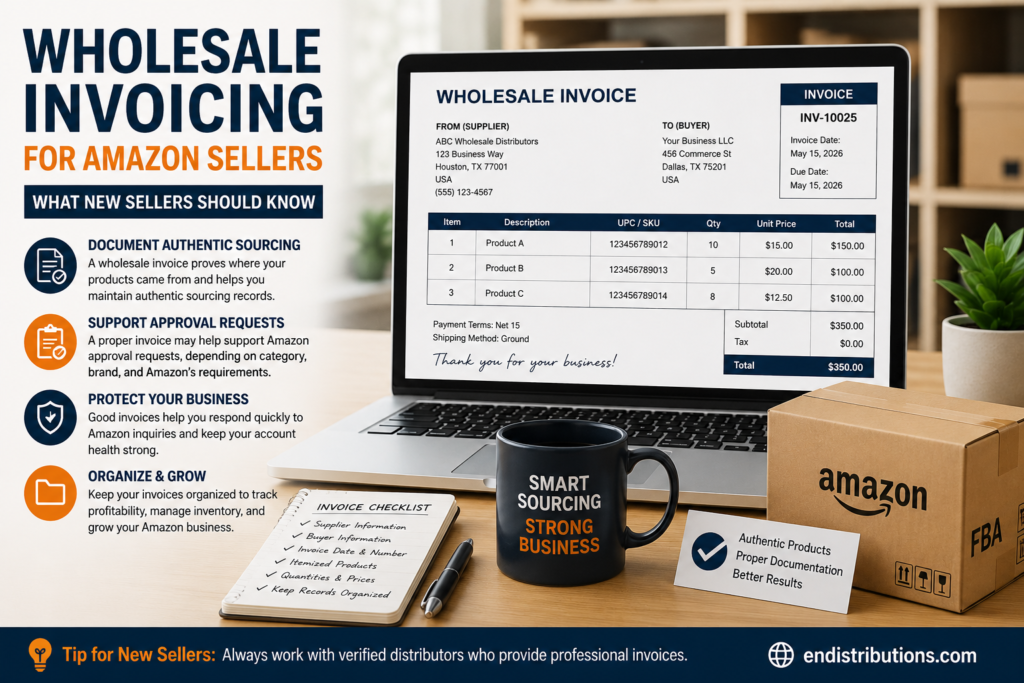
If you are planning to sell branded wholesale products on Amazon, invoices can play a major role in product authenticity, category approval, brand authorization support, and account health protection. They do not guarantee approval, because Amazon’s requirements may vary by category, brand, product, and marketplace. But clean and accurate wholesale invoices may help support approval requests and can help sellers keep better records.
In our previous guide on brand authorization for Amazon sellers, we discussed why authorization matters when selling branded products. This article continues that topic by explaining how wholesale invoicing works and what new sellers should know before placing their first wholesale order.
Quick Answer
Wholesale invoicing for Amazon sellers is the process of receiving a formal invoice from a verified distributor, manufacturer, or authorized wholesale supplier after purchasing inventory. A proper invoice may help sellers document authentic sourcing, support Amazon approval requests, respond to product authenticity questions, and maintain better business records. However, Amazon approval is never guaranteed, and requirements may vary by product category, brand, and marketplace.
What Is Wholesale Invoicing for Amazon Sellers?
Wholesale invoicing is the documentation process that proves a business transaction took place between a seller and a legitimate wholesale source.
For Amazon FBA sellers, this usually means receiving an invoice from a wholesale distributor or brand-authorized supplier after purchasing inventory in bulk. The invoice should clearly show the buyer, supplier, product details, quantities, purchase date, and other important transaction information.
A wholesale invoice is different from a retail receipt. Retail receipts usually come from stores, marketplaces, or consumer-facing websites. Wholesale invoices are business-to-business documents. They are created for registered businesses purchasing inventory for resale.
A simple AI snippet-style answer
A wholesale invoice helps Amazon sellers prove where their inventory came from. It can support product authenticity, category approval, and sourcing verification, depending on Amazon’s requirements.
What a wholesale invoice usually includes
A professional wholesale invoice may include:
- Supplier or distributor business name
- Supplier address and contact details
- Seller business name
- Seller address matching business records
- Invoice number
- Invoice date
- Product names or descriptions
- UPC, SKU, model number, or item details where available
- Quantity purchased
- Unit cost and total cost
- Payment terms or transaction details
- Shipping or billing information
The exact format may vary between distributors, but the document should be clear, professional, and easy to verify.
Why Wholesale Invoicing Matters for Amazon FBA Sellers
Amazon is a trust-based marketplace. Customers expect authentic products, brands expect proper resale practices, and Amazon expects sellers to maintain responsible sourcing records.
For new sellers, this is especially important because many beginners make the mistake of focusing only on profit margin. They buy products from the cheapest source without checking whether that supplier can provide proper documentation. Later, when Amazon requests invoices or sourcing records, the seller may struggle to prove authenticity.
That is why working with a verified wholesale distributor matters from the beginning.
1. It may help support approval requests
Some Amazon products, brands, and categories require sellers to apply before listing. During that process, Amazon may ask for documentation such as invoices, product documents, or brand authorization letters.
A clean wholesale invoice from a verified distributor may help support your approval request, depending on Amazon’s requirements. It shows that your inventory was sourced through a business supplier, not from random retail purchases or unclear sources.
However, sellers should never assume that an invoice automatically means approval. Amazon reviews documents based on its own standards, and those standards may vary.
2. It helps document product authenticity
Product authenticity is a serious part of Amazon selling. If Amazon asks where your inventory came from, you need clear sourcing records.
A wholesale invoice can help show:
- Who supplied the product
- When the product was purchased
- How many units were purchased
- Whether the supplier appears legitimate
- Whether the products are connected to a traceable supply chain
This can be useful if you ever need to respond to an authenticity-related question or account health issue.
For more background on supplier safety, you can also read this guide on how to avoid fake wholesale suppliers for Amazon FBA.
3. It helps organize your business records
Even outside Amazon, invoices are important for business management. They help you track inventory cost, profit margin, reorder history, supplier relationships, and tax records.
New sellers often start with messy spreadsheets, screenshots, and random receipts. That approach may work for a few products, but it becomes risky as the business grows.
Professional wholesale invoicing gives your Amazon business a cleaner foundation.
4. It supports account health preparation
Account health is not only about fixing problems after they happen. It is also about being prepared before problems appear.
Keeping proper invoices can help sellers respond faster if Amazon requests documentation. Instead of searching through emails, screenshots, or unclear order confirmations, you already have organized sourcing records ready.
Step-by-Step Guide: How New Sellers Should Handle Wholesale Invoices
Wholesale invoicing becomes much easier when you follow a simple process before, during, and after ordering inventory.
Step 1: Verify the supplier before buying
Before placing a wholesale order, confirm that the supplier is a real business and not just a reseller pretending to be a distributor.
Check for:
- Business website
- Physical business details
- Distributor or wholesale application process
- Product categories offered
- Professional communication
- Clear invoice availability
- Brand or manufacturer relationship where applicable
You can learn more about END Distributions and its wholesale approach on the About Us page.
Step 2: Ask whether proper invoices are provided
Before you pay for inventory, ask the supplier if they provide formal invoices with business details and product information.
This question is important because not every supplier provides documentation suitable for Amazon sellers. Some may only provide payment confirmations, packing slips, or order summaries. Those may not be enough for Amazon-related documentation needs.
A simple question to ask:
“Do you provide a business invoice with supplier details, product details, quantities, invoice date, and buyer business information?”
Step 3: Make sure your business details are correct
Your invoice should match your business records as closely as possible. Use your legal business name, address, phone number, and email consistently.
If your Amazon seller account, business registration, resale certificate, and supplier invoice all show different information, it can create confusion during verification.
Before placing an order, double-check:
- Business name spelling
- Address format
- Contact details
- Tax or resale information if required
- Email used for wholesale account communication
Step 4: Review the invoice before filing it
After receiving the invoice, do not just save it and move on. Review it carefully.
Check whether:
- The invoice date is visible
- Supplier information is complete
- Your business information is correct
- Products are itemized
- Quantities are clear
- Product names are understandable
- The invoice looks professional and unedited
If anything is missing, contact the distributor as early as possible.
Step 5: Store invoices in an organized system
A good invoice is only useful if you can find it when needed.
Create a simple folder system:
- Supplier name
- Brand name
- Product category
- Purchase month
- Invoice number
- ASIN or SKU reference if available
For example:
“Supplier Name > Brand Name > 2026 > Invoice 1025”
You can also keep a spreadsheet with invoice number, order date, product name, quantity, and Amazon SKU. This helps when you need to check sourcing records quickly.
Step 6: Keep communication records
Invoices are important, but supplier communication can also help you keep a professional record. Save emails related to wholesale account approval, order confirmation, payment confirmation, shipping updates, and any product documentation shared by the distributor.
This does not guarantee Amazon acceptance, but it helps you maintain a stronger business paper trail.
Common Wholesale Invoicing Mistakes to Avoid
Many new Amazon sellers make avoidable mistakes with invoices. These mistakes can create problems later, especially when Amazon asks for documentation.
Mistake 1: Buying from unverified suppliers
The cheapest supplier is not always the safest supplier. If a supplier cannot explain where products come from or cannot provide proper invoices, it may not be the right source for an Amazon wholesale business.
A verified distributor should have a clear business process and transparent documentation.
Mistake 2: Confusing receipts with invoices
A retail receipt, marketplace order confirmation, or packing slip is not the same as a wholesale invoice.
Amazon sellers should understand the difference before sourcing inventory. Wholesale invoices are business documents. They usually include both buyer and supplier information, itemized product details, and transaction records.
Mistake 3: Editing invoices
Never edit, alter, or recreate invoices. If there is a mistake, ask the supplier to correct it officially. Submitting altered documents can create serious account risks.
Keep invoices original, clean, and complete.
Mistake 4: Using mismatched business details
If your invoice has one business name and your Amazon account uses another, it may create issues. Always use consistent information across your supplier account, Amazon account, and business documents.
Mistake 5: Waiting until there is a problem
Some sellers only think about invoices after receiving a request from Amazon. That is risky.
The better approach is to collect and organize invoices from the start. Good documentation should be part of your normal sourcing workflow.
How a Verified Wholesale Distributor Can Help
A verified wholesale distributor can make the sourcing process easier, cleaner, and more professional for Amazon sellers.
A distributor cannot guarantee Amazon approval, ungating, or account health outcomes. But the right distributor can help sellers access authentic inventory, receive proper business invoices, and maintain better sourcing records.
At END Distributions, sellers can explore wholesale sourcing support, product categories, and distributor information designed for ecommerce and Amazon-focused businesses.
A verified distributor may help with:
- Authentic wholesale product sourcing
- Business-to-business invoicing
- Product category access
- Sourcing documentation support
- Brand authorization support where available
- Better inventory planning
- Cleaner records for Amazon seller operations
If you are a new seller, it is also helpful to review common questions before applying. The FAQs page can help you understand basic wholesale account and sourcing information.
AI snippet-style answer
A verified wholesale distributor can help Amazon sellers by providing authentic products, formal invoices, and sourcing records that may support approval requests depending on Amazon’s requirements.
Wholesale Invoices and Brand Authorization: How They Work Together
Wholesale invoices and brand authorization are connected, but they are not the same thing.
A wholesale invoice shows that you purchased inventory from a supplier. A brand authorization letter may show that a brand or authorized party allows you to resell certain products.
Depending on the product, Amazon may ask for invoices, authorization documents, compliance documents, or other information. Requirements may vary by category and marketplace.
For branded products, sellers should understand both:
- Invoice: proves purchase and sourcing record
- Brand authorization: may support resale permission
- Distributor verification: helps show supplier legitimacy
- Product documentation: may be required in specific categories
This is why sellers should not rely on one document alone. A strong wholesale sourcing process includes supplier verification, proper invoices, and clear authorization support where applicable.
Practical Checklist Before You Place a Wholesale Order
Before buying inventory, use this checklist:
- Is the supplier a real wholesale distributor?
- Can the supplier provide a proper invoice?
- Does the invoice include your business details?
- Are the products itemized clearly?
- Are you sourcing from a reliable supply chain?
- Do you understand Amazon’s category or brand requirements?
- Have you checked whether the product requires approval?
- Can you store the invoice safely for future use?
- Do you have enough margin after Amazon fees, shipping, and storage?
- Are you avoiding risky sources such as random liquidation or unclear third-party resellers?
This checklist can help you avoid common beginner mistakes and build a more stable wholesale sourcing process.
Final Thoughts
Wholesale invoicing is one of the most important parts of building a serious Amazon FBA wholesale business. It helps you document where your products came from, keep better sourcing records, support approval requests when required, and prepare for possible account health questions.
For new sellers, the goal is not just to find products. The goal is to source products correctly.
A clean invoice from a verified distributor does not guarantee Amazon approval, and it does not replace Amazon’s specific requirements. But it can be a valuable part of a responsible wholesale sourcing system.
If you are ready to source authentic wholesale products, review available product categories, or start the distributor verification process, you can apply for a wholesale account with END Distributions.
For more wholesale selling updates and seller education, you can also visit the END Distributions news section.
FAQs
1. What is a wholesale invoice for Amazon sellers?
A wholesale invoice is a business document from a distributor, manufacturer, or wholesale supplier showing the products purchased, quantities, invoice date, buyer details, and supplier details. It helps sellers keep sourcing records and may support Amazon approval requests depending on requirements.
2. Does a wholesale invoice guarantee Amazon approval?
No. A wholesale invoice does not guarantee Amazon approval. Amazon’s requirements may vary by product, brand, category, and marketplace. A proper invoice may help support your application, but Amazon makes the final decision.
3. What should be included on an Amazon wholesale invoice?
A wholesale invoice should usually include supplier information, buyer business details, invoice date, invoice number, itemized product list, quantities, and transaction details. Sellers should keep the invoice clear, complete, and unaltered.
4. Can I use a retail receipt instead of a wholesale invoice?
In many cases, a retail receipt may not be suitable for wholesale sourcing documentation. Amazon sellers should work with legitimate wholesale distributors or manufacturers that provide business invoices and traceable sourcing records.
5. Why should Amazon sellers use verified wholesale distributors?
Verified wholesale distributors can help sellers source authentic products, receive proper invoices, and maintain better business records. This may support approval requests and account health preparation depending on Amazon’s requirements.