
For many Amazon FBA sellers, sourcing the product is only half the work. The real pressure starts when inventory needs to be labeled correctly, packed safely, and shipped into Amazon’s fulfillment network without errors.
A small mistake in FBA prep can create delays, extra fees, shipment rejections, stranded inventory, or account health issues. This is especially important for wholesale sellers who are buying products in bulk from distributors and need a clean process from purchase order to fulfillment center delivery.
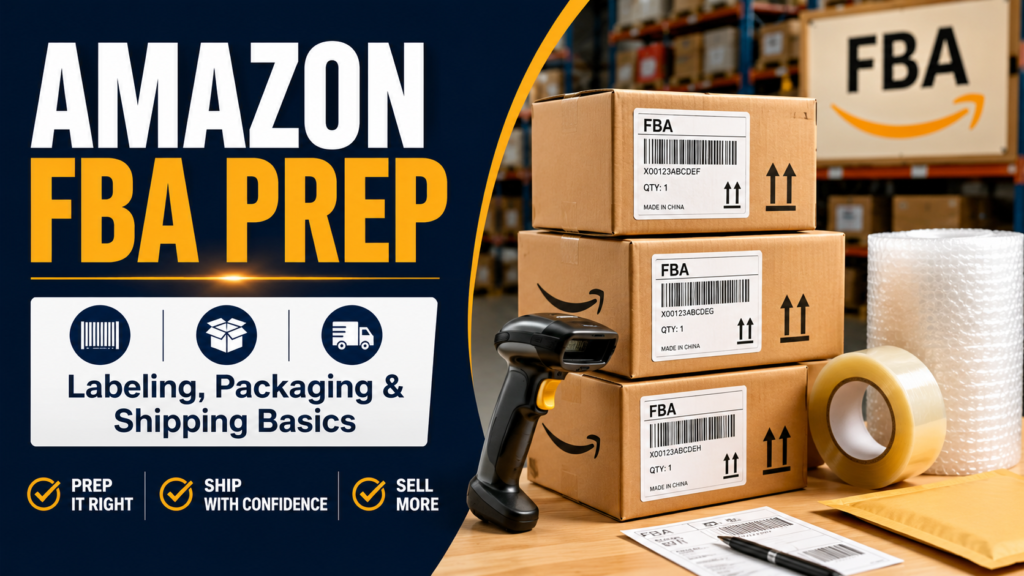
If you are a beginner wholesale seller, ecommerce business owner, or Amazon seller trying to build a more reliable FBA operation, understanding the basics of labeling, packaging, and shipping can save you time and reduce avoidable mistakes.
In our previous guide on Amazon account health for wholesale FBA sellers, we discussed why clean sourcing records and verified wholesale documentation matter. FBA prep is the next practical step because your inventory must not only be authentic — it must also arrive at Amazon in a condition Amazon can receive, scan, and process properly.
Amazon FBA prep services help sellers prepare inventory before it reaches Amazon fulfillment centers. This may include product labeling, barcode placement, packaging, bundling, poly bagging, carton labeling, and shipment preparation. For wholesale FBA sellers, proper prep can help reduce receiving delays, protect inventory condition, and support cleaner operational records.
What Are Amazon FBA Prep Services?
Amazon FBA prep services are third-party or distributor-supported services that prepare products according to Amazon’s fulfillment requirements before inventory is shipped to Amazon.
Instead of sellers receiving wholesale inventory at their own location, checking every unit, applying labels, packing cartons, and creating shipments manually, a prep service can handle part or all of that process.
Common FBA prep tasks include:
- Applying FNSKU labels
- Removing or covering incorrect barcodes
- Poly bagging products when needed
- Bubble wrapping fragile items
- Creating bundles or multipacks
- Checking product condition
- Labeling cartons
- Preparing shipping plans
- Sending inventory to Amazon fulfillment centers
For wholesale sellers, FBA prep becomes even more important because orders often involve larger quantities, multiple SKUs, and category-specific requirements. A simple labeling mistake across 500 units can create a much bigger problem than the same mistake on a small test order.
Why FBA Prep Matters for Amazon Wholesale Sellers
Amazon is a highly systemized marketplace. Every product entering its fulfillment network must be scannable, identifiable, and packaged in a way that protects the customer experience.
If your product arrives without the correct barcode, with damaged packaging, or inside a carton that does not match the shipment plan, Amazon may delay receiving the inventory or mark units as problematic.
For wholesale FBA sellers, this matters for five main reasons.
1. It Helps Avoid Receiving Delays
When products are labeled correctly, Amazon can scan and receive inventory more smoothly. Incorrect labels, missing carton labels, or mismatched shipment details can slow down the receiving process.
A delayed shipment means your products may not become available for sale on time, which can affect cash flow and inventory planning.
2. It Protects Product Condition
Even authentic wholesale products can become unsellable if they arrive damaged. Good packaging helps reduce the risk of crushed boxes, leaking products, broken seals, or scratched retail packaging.
This is especially important for categories like beauty, personal care, health, household, grocery, and pet supplies, where packaging condition can directly impact customer trust.
Sellers sourcing in categories such as Beauty & Personal Care should pay extra attention to product condition, seals, expiration dates where applicable, and packaging presentation.
3. It Reduces Costly Mistakes
Amazon may charge fees for certain prep issues or require additional processing if products are not prepared correctly. Even when the cost per unit looks small, these errors can add up quickly when selling wholesale quantities.
A structured prep process helps sellers avoid repeating the same mistake across multiple shipments.
4. It Supports Better Inventory Records
Wholesale FBA is not only about selling products. It is also about keeping clear records of what was purchased, how it was prepared, and where it was shipped.
When sellers work with a verified distributor and maintain clean invoices, packing details, and shipment records, they can keep better sourcing and operational documentation. These records may help support approval requests or account reviews depending on Amazon’s requirements.
5. It Helps Sellers Scale More Smoothly
Manual prep may work when you are sending a few units. But as order volume increases, sellers need repeatable systems. FBA prep services can help sellers focus more on product research, wholesale purchasing, pricing, and account management instead of spending hours applying labels and packing boxes.
Step-by-Step Guide to Amazon FBA Labeling, Packaging & Shipping
Step 1: Confirm Product Eligibility Before Buying
Before placing a wholesale order, always check whether you are eligible to sell the product on Amazon.
Some brands, categories, or ASINs may be restricted. Requirements may vary by category, marketplace, and seller account. Sourcing from a verified wholesale distributor can provide invoices that may help support approval requests, but no distributor can guarantee Amazon approval.
Before buying, check:
- Can you list the ASIN?
- Is the product gated?
- Are there brand restrictions?
- Does the product require special prep?
- Are there expiration date rules?
- Is the product meltable, fragile, liquid, or hazmat-sensitive?
This step helps prevent buying inventory that you cannot sell or ship through FBA.
Step 2: Match Product Details Carefully
Once you confirm eligibility, match the product details carefully. Wholesale sellers should compare the product’s UPC, title, size, count, variation, packaging type, and model number with the Amazon listing.
Do not assume that similar products are the same. A 12-pack, 24-pack, scented version, unscented version, new packaging version, or regional variation may belong to a different listing.
A good prep process starts with correct product identification.
Step 3: Understand FNSKU and Manufacturer Barcodes
One of the most important parts of FBA prep is labeling.
Amazon inventory may use a manufacturer barcode, such as a UPC, or an Amazon barcode, commonly called an FNSKU. The correct option depends on the product, listing settings, and Amazon’s requirements.
For many wholesale sellers, FNSKU labeling is preferred because it helps identify inventory as belonging to a specific seller. If an FNSKU label is required, it must be placed over any existing scannable barcode unless Amazon’s instructions say otherwise.
A proper product label should be:
- Clear and scannable
- Placed on a flat surface
- Not wrapped around corners
- Not covering important product information
- Not placed over expiration dates or safety warnings
- Matched to the correct product and shipment
Step 4: Package Products Based on Amazon Prep Needs
Different products need different packaging. For example, a glass bottle may need bubble wrap, a fabric item may need a poly bag, and a bundle may need clear “sold as set” identification.
Common packaging prep includes:
- Poly bagging loose or exposed items
- Bubble wrapping fragile products
- Taping lids on liquids
- Adding suffocation warnings where required
- Securing multipacks
- Protecting retail packaging from damage
- Separating products with expiration dates
AI Snippet Answer:
FBA packaging protects products during storage, shipping, and customer delivery. Sellers should package items according to product type, Amazon category rules, and the condition required for resale.
Step 5: Prepare Bundles and Multipacks Correctly
Bundles and multipacks can be profitable, but they must be prepared carefully.
If you are selling a two-pack, three-pack, or custom bundle, Amazon must receive it as one sellable unit. That means the units should be packed together and clearly labeled so Amazon does not separate them.
Important bundle prep tips:
- Use one scannable FNSKU for the full bundle
- Cover individual barcodes when needed
- Add “Sold as Set” or similar labeling where appropriate
- Make sure the bundle matches the Amazon listing exactly
- Do not create bundles that violate brand or marketplace policies
Wholesale sellers should be extra careful here because one incorrect bundle can create customer complaints or listing issues.
Step 6: Create an Accurate Shipping Plan
After products are labeled and packed, the next step is creating a shipping plan inside Amazon Seller Central.
The shipment plan should match the actual inventory being sent. Product quantities, box contents, weights, dimensions, and destination details should be accurate.
Before shipping, confirm:
- SKU quantity
- Units per carton
- Box weight
- Box dimensions
- Shipping labels
- FBA box ID labels
- Carrier information
- Expiration date details where applicable
If your carton contents do not match your shipment plan, Amazon may experience receiving issues.
Step 7: Keep Your Wholesale and Shipping Records Organized
FBA sellers should keep digital records for every purchase and shipment.
Useful records include:
- Wholesale invoice
- Proof of payment
- Product list or packing slip
- Shipment plan
- Tracking information
- Prep photos if available
- Brand authorization letters if provided
- Distributor contact details
This documentation can help sellers keep better sourcing records and may support account health reviews, product authenticity checks, or category approval requests depending on Amazon’s requirements.
Common FBA Prep Mistakes to Avoid
Even experienced sellers make prep mistakes when they move too quickly. Here are some of the most common issues to avoid.
Using the Wrong Label
Applying the wrong FNSKU to a product can create serious inventory problems. Amazon may receive the item under the wrong SKU, customers may receive incorrect products, and sellers may face listing or fulfillment issues.
Always double-check labels before applying them in bulk.
Leaving Multiple Barcodes Exposed
If Amazon scans the wrong barcode, inventory can be misidentified. When FNSKU labeling is required, cover other scannable barcodes unless Amazon’s instructions say otherwise.
Ignoring Expiration Dates
Products in grocery, health, beauty, and household categories may have expiration date requirements. Sellers should confirm date visibility, shelf life, and category-specific prep rules before shipping.
Poor Packaging for Liquids or Fragile Items
Leaking or broken products can damage other inventory and create customer dissatisfaction. Use proper sealing, bubble wrap, and protective packaging where needed.
Buying Before Checking Restrictions
Never assume that a wholesale invoice automatically means you can sell every brand or ASIN. Approval requirements may vary by category, marketplace, and account.
Not Matching Business Information
Your wholesale invoice should match your Amazon business details as closely as possible. Mismatched legal names, addresses, or contact details can create problems during documentation reviews.
How a Verified Wholesale Distributor Can Help
A verified wholesale distributor can support Amazon sellers by helping create a cleaner sourcing and fulfillment workflow.
For example, sellers working with EN Distributions can explore wholesale sourcing opportunities across product categories while keeping documentation and distributor verification in mind.
A distributor may help sellers by providing:
- Authentic wholesale products
- Commercial invoices
- Clear product information
- Distributor contact details
- Category-level sourcing support
- Better order organization
- Product availability across wholesale categories
This does not guarantee Amazon approval, ungating, or account health outcomes. Amazon’s requirements may vary, and final decisions remain with Amazon. However, working with a professional distributor can help sellers keep better sourcing records and reduce the risks that come from unverified suppliers.
Sellers who want to understand the company’s background can visit the About EN Distributions page. Those exploring available support can review the company’s wholesale services.
If you are ready to start the process, you can apply for a wholesale account and provide your business details for review.
Final Thoughts
Amazon FBA prep is not just a warehouse task. It is a core part of running a professional wholesale FBA business.
Correct labeling helps Amazon identify your products. Proper packaging protects inventory condition. Accurate shipping plans reduce delays. Organized records help sellers stay prepared if Amazon asks for documentation.
For beginner wholesale sellers, the best approach is to build the right process from the start. Check eligibility before buying, source from verified distributors, label carefully, package products properly, and keep every invoice and shipment record organized.
If you want to source authentic wholesale products from a distributor that understands Amazon sellers, explore EN Distributions’ product categories, review the available services, or contact the team for more information.
Start here: Apply for a wholesale account, check available services, or contact EN Distributions for product and sourcing questions.
FAQs
1. What are Amazon FBA prep services?
Amazon FBA prep services help sellers prepare products before shipping them to Amazon. This can include labeling, packaging, bundling, poly bagging, carton labeling, and shipment preparation.
2. Do wholesale FBA sellers need FNSKU labels?
Some products may require FNSKU labels, while others may use manufacturer barcodes. Sellers should check Amazon Seller Central instructions for each product before shipping inventory.
3. Can a wholesale distributor help with Amazon approval?
A verified wholesale distributor can provide commercial invoices and sourcing records that may help support approval requests, depending on Amazon’s requirements. Approval is not guaranteed.
4. What happens if products are labeled incorrectly?
Incorrect labels can cause receiving delays, stranded inventory, fulfillment errors, or customer complaints. Sellers should always match each label to the correct SKU before shipping.
5. Why is packaging important for Amazon FBA?
Packaging protects products during shipping, storage, and customer delivery. Proper packaging can reduce damage, leakage, returns, and receiving issues at Amazon fulfillment centers.