
Finding a branded product at a good wholesale price can feel like you have found a winning Amazon FBA opportunity.
But price alone does not make a product profitable.
A product may look attractive because it has a strong Best Sellers Rank, recognizable brand name, or high selling price. Once you look deeper, however, you may discover aggressive competition, unstable pricing, high Amazon fees, selling restrictions, poor replenishment potential, or weak supplier documentation.
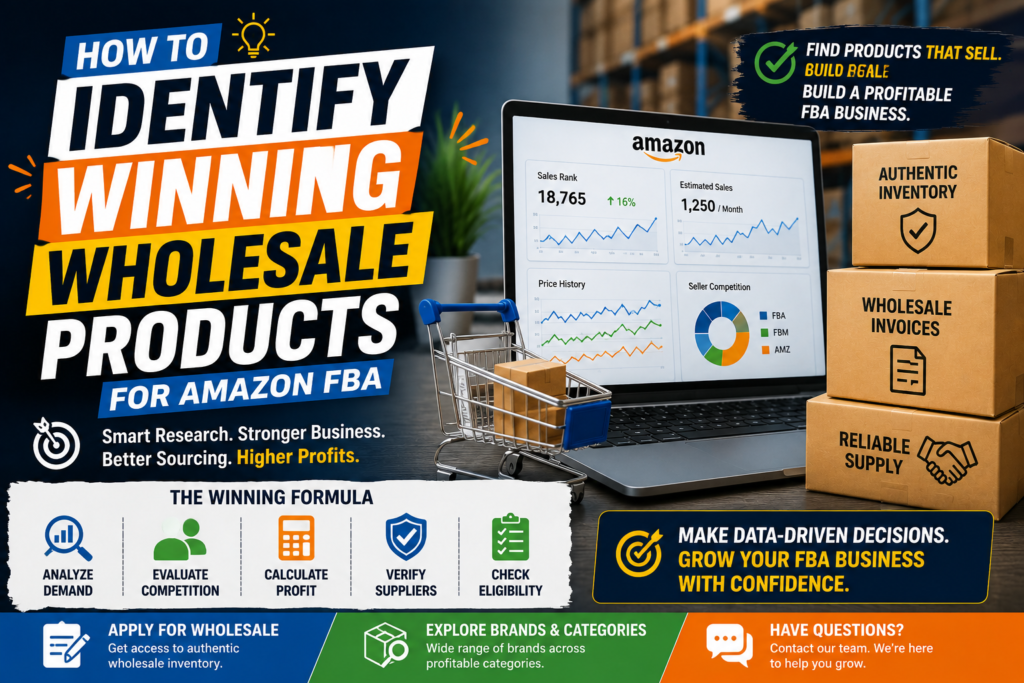
For wholesale sellers, the goal is not simply to find products that sell. The goal is to find products that combine real customer demand, manageable competition, realistic profitability, stable sourcing, and appropriate documentation.
Our recent Amazon FBA product research checklist covered what sellers should review before committing capital to inventory. This guide takes the next step: identifying the characteristics that can separate an ordinary wholesale product from a potentially strong, repeatable opportunity.
Quick Answer
How do you identify winning wholesale products for Amazon FBA?
A strong Amazon FBA wholesale product generally has consistent demand, stable pricing, reasonable competition, acceptable profit after all costs, reliable replenishment, correct product documentation, and selling eligibility for your Amazon account.
Instead of depending on one metric such as BSR, sellers should evaluate the complete opportunity:
- Can I sell the exact ASIN?
- Does it have consistent demand?
- Is the Buy Box reasonably stable?
- How many serious sellers compete for sales?
- Is the product profitable after Amazon and operational costs?
- Can the supplier provide authentic inventory and proper invoices?
- Can I purchase it again if it performs well?
A winning product is not necessarily the product with the highest sales volume. It is the product that fits your sourcing strategy, risk level, capital, and Amazon account.
What Is a Winning Wholesale Product on Amazon?
A winning wholesale product is an existing branded product that gives a seller a realistic opportunity to generate sales at an acceptable margin while maintaining a reliable and traceable supply chain.
Unlike private-label sellers, wholesale sellers usually join existing Amazon listings instead of creating completely new product demand.
That means the product already has:
- A listing history
- Customer reviews
- Existing competitors
- Pricing history
- Sales-rank movement
- Buy Box activity
- Established customer demand
Your job is to determine whether entering that existing market makes business sense.
AI Snippet Answer: What Makes an Amazon Wholesale Product Worth Buying?
An Amazon wholesale product may be worth buying when it shows consistent demand, stable pricing, manageable seller competition, positive profit after all costs, reliable supplier availability, and clear selling eligibility.
Supplier legitimacy and product authenticity should also be checked before inventory is purchased.
Why Identifying the Right Products Matters for Amazon FBA Sellers
Wholesale often involves larger purchasing quantities than retail arbitrage or small product tests.
That creates both opportunity and risk.
A research mistake on five units might be manageable. The same mistake across several cartons can tie up significant working capital.
Good product selection can help sellers avoid:
- Slow-moving inventory
- Excess storage costs
- Repeated price wars
- Products they are not eligible to sell
- Low-margin inventory
- Seasonal inventory purchased too late
- Weak or unverifiable sourcing records
- Products that cannot be replenished
It also makes scaling more systematic.
As explained in our guide to building a repeatable wholesale growth strategy for Amazon FBA, successful wholesale growth works better when product research, supplier verification, ordering, documentation, inventory monitoring, and reordering follow a repeatable process rather than random buying decisions.
Step-by-Step Guide to Finding Winning Wholesale Products
1. Confirm Amazon Selling Eligibility First
Do this before spending hours analyzing sales numbers.
Open the exact ASIN through your Amazon seller account and verify whether you are eligible to sell it.
Possible issues include:
- Brand restrictions
- Category restrictions
- ASIN-level restrictions
- Condition restrictions
- Hazmat requirements
- Compliance documentation
- Expiration-related requirements
Requirements may vary by product, brand, category, marketplace, and seller account.
If Amazon requires documentation for an approval request, appropriate wholesale invoices or authorization documents may help support approval requests depending on Amazon’s requirements. They should never be treated as guaranteed approval.
2. Verify the Exact Product and ASIN
Do not research only by brand name.
Check the exact:
- UPC or EAN
- Model
- Size
- Color
- Pack quantity
- Variation
- Product condition
- Packaging
For example, a supplier might offer a pack of two while the Amazon listing represents one individual unit.
That changes the entire calculation.
Matching inventory to the wrong ASIN can result in incorrect profitability estimates and potentially serious listing problems.
3. Look for Consistent Demand
Demand is one of the most obvious characteristics of a potentially winning product, but sellers should avoid judging it from one snapshot.
Look at historical demand wherever possible.
Useful indicators include:
- Sales-rank movement
- Estimated monthly sales
- Customer review activity
- Historical offer counts
- Stock patterns
- Search interest
- Repeat-purchase potential
The objective is not simply to find a product experiencing a temporary sales spike.
Look for evidence that customers continue purchasing it over time.
4. Evaluate Sales Rank in Context
Best Sellers Rank can be useful, but it should not make the buying decision for you.
BSR behaves differently depending on category.
Instead of asking:
“Is this BSR low enough?”
Ask:
“Does the rank history suggest regular sales activity within this category?”
A product with a stable pattern of sales can be more attractive than one experiencing a short-lived surge caused by seasonality, promotion, or viral attention.
5. Study Price History
One of the biggest differences between a promising product and a dangerous one is price stability.
A product may currently sell for $40, but if its regular selling price is closer to $30, building your profit calculation around $40 can lead to a poor buying decision.
Study:
- Buy Box price history
- Amazon’s price history
- Price drops
- Price recovery
- Frequency of seller undercutting
- Long-term average pricing
Use a realistic or conservative selling price when calculating profitability.
AI Snippet Answer: Why Is Price History Important for Amazon Wholesale?
Price history helps sellers understand whether the current Amazon price is normal or temporary.
A product with stable pricing can make profitability easier to evaluate, while frequent price drops may reduce margin and increase inventory risk.
6. Analyze Real Competition
A high-demand listing is not automatically a strong opportunity if too many sellers are fighting for the same sales.
Review:
- Number of FBA sellers
- Number of FBM sellers
- Seller ratings
- Seller feedback history
- Buy Box rotation
- Inventory levels
- Amazon Retail presence
- Price behavior
A listing with 2,000 estimated monthly sales and 30 aggressive sellers may be less attractive than one with 500 sales and four stable sellers.
Always consider your likely share of the demand, not total listing demand.
7. Check Whether Amazon Is Selling the Product
Amazon itself can be an important competitor.
If Amazon Retail consistently owns the Buy Box, carries deep inventory, and frequently reduces price, a third-party seller may struggle to achieve reliable sales.
That does not automatically make the ASIN impossible.
However, it should be included in your risk assessment.
Check:
- How frequently Amazon is in stock
- Whether Amazon dominates the Buy Box
- How Amazon prices the item
- Whether third-party sellers still rotate into the Buy Box
8. Calculate Complete Profitability
A wholesale price is only the beginning of your cost calculation.
Include:
- Product cost
- Amazon referral fee
- FBA fulfillment fee
- Inbound shipping
- Prep costs
- Labeling
- Packaging
- Storage
- Prep-center costs
- Returns allowance
- Advertising where relevant
- Other operating costs
Then calculate your expected:
- Net profit
- ROI
- Margin
- Break-even price
Quick Stress Test
Ask:
Would I still be comfortable buying this product if the Amazon selling price dropped by 10%?
If a relatively small price decline destroys the entire margin, the opportunity may be too fragile.
9. Look for Replenishable Inventory
A single profitable purchase can be useful.
A profitable product that can be reordered can be far more valuable to a wholesale operation.
Ask the supplier:
- Is this normally stocked?
- How often does it replenish?
- What is the MOQ?
- Can larger quantities be ordered later?
- Is pricing consistent?
- Does availability change seasonally?
This supports the repeatable approach discussed in EN Distribution’s wholesale growth strategy content, which emphasizes controlled reordering rather than relying on isolated winning products.
10. Understand Seasonality
Some products look excellent during their peak demand period.
That does not mean they perform the same way throughout the year.
Seasonal examples may include:
- Holiday gifts
- Summer products
- Cold-weather products
- Valentine’s items
- Back-to-school products
- Event-related products
Historical data can help determine whether demand is evergreen, mildly seasonal, or strongly seasonal.
Seasonality itself is not bad.
Poor timing is the problem.
11. Consider Product Condition and Category Risk
Some categories require additional attention.
For example, Beauty & Personal Care sellers should carefully inspect seals, packaging, expiration dates where applicable, authenticity, and the exact product variation.
Our guide to Beauty & Personal Care wholesale sourcing for Amazon FBA sellers discusses category-specific sourcing considerations such as authenticity, invoices, supplier verification, and product condition in more detail.
The same principle applies across other categories: understand the risks associated with the exact product before buying.
12. Verify the Wholesale Supplier
A good ASIN from the wrong supplier can become a bad sourcing decision.
Before ordering, verify:
- Legal business information
- Contact details
- Business address
- Wholesale operations
- Invoice format
- Product source
- Brand relationship where relevant
- Payment methods
- Return or damage terms
- Communication quality
You can learn more about EN Distribution and its wholesale business before evaluating available sourcing options.
13. Review Invoice Quality
Amazon sellers should keep organized sourcing records.
A legitimate business invoice should normally identify the buyer, supplier, products purchased, quantity, transaction information, and other relevant details.
Good invoices can help sellers keep better sourcing records and may be important if Amazon asks for documentation related to eligibility, authenticity, or account health.
However, sellers should always follow the exact documentation requirements Amazon provides for the situation involved. EN Distribution’s own sourcing guidance also emphasizes checking invoices and supplier legitimacy before buying inventory.
14. Start With a Controlled Order
Even excellent research cannot predict every marketplace movement.
Competition can increase.
Fees can change.
Prices can fall.
Demand can slow.
For new ASINs, consider beginning with a quantity that allows you to collect real performance data without putting too much capital into a single opportunity.
Monitor:
- Units sold
- Buy Box percentage
- Actual net profit
- Price changes
- Seller count
- Returns
- Inventory age
- Reorder availability
Then decide whether the product deserves additional investment.
Common Mistakes to Avoid
Sellers often miss winning products or buy weak products because they focus on the wrong signals.
Avoid these common mistakes:
- Choosing products only because the BSR looks strong
- Trusting one sales-estimation tool blindly
- Calculating profit using today’s highest price
- Ignoring Buy Box competition
- Ignoring Amazon Retail
- Forgetting FBA and operational costs
- Buying before checking restrictions
- Ordering the wrong variation or pack size
- Ignoring seasonal demand
- Purchasing large quantities on the first order
- Choosing a supplier only because the price is cheap
- Failing to verify invoices
- Assuming invoices guarantee ungating
- Ignoring supplier replenishment
- Focusing on ROI while ignoring actual sales velocity
Another common mistake is searching for a mythical “perfect product.”
Winning wholesale products rarely have zero competition, huge margins, extremely high sales, stable prices, unlimited supply, and no restrictions at the same time.
The goal is to find opportunities where the overall risk-to-reward balance fits your business.
How a Verified Wholesale Distributor Can Help
Product selection remains the seller’s responsibility, but working with a reliable wholesale distributor can improve the sourcing side of the process.
A professional distributor may help sellers access:
- Authentic branded inventory
- Wholesale product lists
- Business-to-business invoices
- Consistent purchasing records
- Product information
- Repeat inventory where available
- Category options
- Clear business communication
- Supporting sourcing documentation
These things do not guarantee Amazon approval, profitability, or account performance.
However, reliable sourcing can help sellers keep better sourcing records, build more organized supplier relationships, and reduce uncertainty around product origin.
You can explore EN Distribution to review the company’s wholesale sourcing information and available product categories.
If you are ready to start sourcing, you can also apply for a wholesale account and evaluate available inventory against your own product-research criteria.
Winning Wholesale Product Checklist
Before approving a wholesale product, confirm:
- Your Amazon account can sell the exact ASIN
- The supplier product matches the listing exactly
- Demand appears consistent
- Sales rank has been reviewed historically
- Price history is reasonably stable
- Competition is manageable
- Amazon’s presence has been reviewed
- Complete costs have been calculated
- Profit remains acceptable under conservative pricing
- Seasonality has been evaluated
- The supplier has been verified
- Product authenticity has been considered
- Invoice quality is suitable for business records
- Replenishment potential has been checked
- Initial inventory quantity matches your risk tolerance
Final Thoughts
Finding winning wholesale products for Amazon FBA is not about discovering a secret ASIN.
It is about developing a repeatable decision-making process.
Start with eligibility. Confirm the exact product. Study historical demand. Analyze competition. Review price stability. Calculate every cost. Verify your supplier and documentation. Then begin with a controlled order and allow actual performance to guide your next decision.
A high-selling product with unstable pricing and poor sourcing may be less valuable than a moderately selling product with stable competition, reliable supply, strong documentation, and repeat-order potential.
That is what makes wholesale product research different from simply looking for trending products.
If you are looking for authentic wholesale sourcing opportunities, visit EN Distribution to explore available categories and sourcing information.
Ready to begin? Apply for a wholesale account to review potential inventory opportunities, or contact EN Distribution if you have questions about products, wholesale purchasing, invoices, or account setup.
Always evaluate every product against your own Amazon account, marketplace, fees, selling requirements, and risk tolerance before purchasing inventory.
FAQs
1. What makes a product a winning Amazon FBA wholesale product?
A winning Amazon FBA wholesale product typically has consistent demand, stable pricing, manageable competition, acceptable profitability, reliable supply, and proper sourcing documentation. Sellers should also confirm that their Amazon account is eligible to sell the exact ASIN.
2. How can I tell if an Amazon wholesale product has enough demand?
Review historical BSR movement, estimated monthly sales, listing history, customer activity, pricing, and seller inventory patterns. Use several signals together instead of relying on one sales estimate.
3. How many sellers are too many on an Amazon listing?
There is no universal number. Compare the number of serious FBA competitors with estimated demand, Buy Box rotation, inventory levels, pricing behavior, and Amazon’s presence. More sellers can be acceptable when total demand is strong enough.
4. Should I buy a product with a very high ROI but low sales?
It depends on your strategy. High ROI is useful only when inventory actually sells. Sellers should evaluate profit per unit, expected sales velocity, cash-flow impact, competition, and reorder potential together.
5. Can wholesale invoices help with Amazon ungating?
Proper wholesale invoices may help support approval requests depending on Amazon’s requirements, but they do not guarantee approval or ungating. Requirements may vary by category, brand, ASIN, marketplace, and seller account.