
For Amazon FBA sellers, buying products is only one part of the business. The real challenge is proving that your products come from a reliable source when Amazon asks for documentation.
Many new sellers focus only on product price, profit margin, and sales rank. Those things matter, but they are not enough. If your invoice is incomplete, unclear, or from a supplier Amazon cannot verify, it may create problems during approval requests, authenticity reviews, or account health checks.
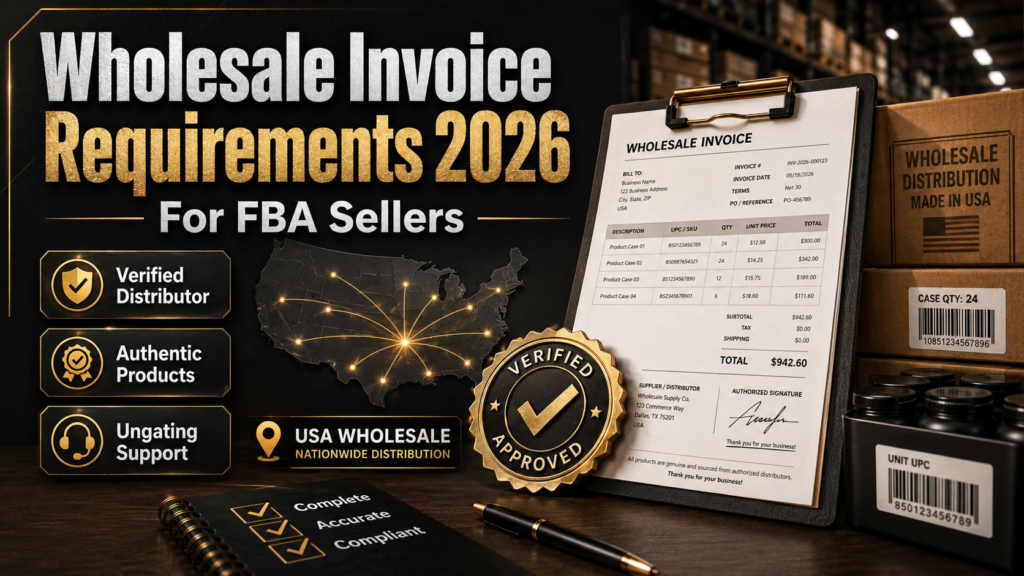
This is why understanding Amazon wholesale invoice requirements is important before you place your first wholesale order. A proper invoice may help support product approval or ungating requests, depending on Amazon’s requirements, but it should never be treated as a guaranteed approval document.
In our previous guides, we explained how to check if a wholesale supplier is legit, how wholesale invoices can support approval requests, and the basics of FBA prep. This article connects those topics and explains what FBA sellers should look for in a wholesale invoice in 2026.
An Amazon wholesale invoice should clearly show the supplier’s business name, supplier contact details, buyer business information, invoice date, invoice number, product details, quantities purchased, and transaction information. For some product approval requests, Amazon may ask for invoices issued within a recent time period and showing a minimum quantity purchased. Requirements may vary by category, brand, marketplace, and seller account.
What Are Amazon Wholesale Invoice Requirements?
Amazon wholesale invoice requirements refer to the details Amazon may review when a seller submits supplier documents for approval, ungating, authenticity verification, or compliance checks.
A wholesale invoice is not the same as a retail receipt. A receipt usually proves that a consumer bought something from a store. A wholesale invoice shows a business-to-business purchase between a supplier and a reseller.
For Amazon FBA sellers, a strong wholesale invoice usually includes:
- Supplier business name
- Supplier address
- Supplier phone number or email
- Buyer business name
- Buyer address
- Invoice number
- Invoice date
- Product names or descriptions
- Quantity purchased
- Unit price or order total
- Clear transaction details
The goal is simple: Amazon should be able to understand who sold the products, who purchased them, when the purchase happened, and what products were included.
Why Invoice Requirements Matter for Amazon FBA Sellers
Amazon wants to protect customers, brands, and the marketplace. If a seller lists products from unclear sources, it can lead to authenticity complaints, restricted product issues, expired inventory problems, or poor customer experience.
Wholesale invoices help sellers keep cleaner sourcing records. They may also help sellers respond more professionally when Amazon requests documentation.
They May Support Ungating Requests
Some categories, brands, or products require approval before sellers can list them. This is commonly called ungating.
A wholesale invoice may help support an approval request because it shows that the seller purchased inventory from a business supplier. However, Amazon approval is not guaranteed. Amazon may accept, reject, or request more information depending on the category, marketplace, brand, seller history, and document quality.
They Help With Product Authenticity Records
If Amazon questions product authenticity, sellers may need to show where the products came from. A clear invoice from a verified distributor can help sellers maintain better records.
This does not mean the invoice alone solves every account issue. Sellers should also check product condition, packaging, expiration dates, safety rules, and brand restrictions before buying.
They Protect Better Business Organization
Even outside Amazon approval requests, invoices are important for business records. They help you track purchase cost, inventory, reorder history, tax records, and supplier relationships.
A serious wholesale seller should save every invoice, shipment record, supplier email, and product list in an organized folder.
Step-by-Step Guide: How to Prepare a Strong Amazon Wholesale Invoice
Step 1: Buy From a Verified Wholesale Distributor
The first step is choosing the right supplier. If your supplier is not reliable, the invoice may not help much.
Before buying, check whether the distributor has:
- A professional website
- Clear business information
- Business email and contact details
- Product categories
- Wholesale application process
- Real communication
- Proper invoice process
- Clear shipping or fulfillment support
You can learn more about EN Distributions and its wholesale sourcing focus on the About Us page.
Step 2: Make Sure Your Business Details Match
Your invoice should show your correct business information. If your Amazon seller account uses a business name and address, try to keep your wholesale account details consistent.
Mismatched information can create confusion during document review. For example, if your Amazon account uses one business name but the invoice shows a completely different name, Amazon may ask questions or reject the document.
Before placing an order, check:
- Business name
- Contact person
- Address
- Phone number
- Tax or resale information if applicable
Accuracy matters more than sellers realize.
Step 3: Check Supplier Information on the Invoice
A strong invoice should clearly show the supplier’s business details. Amazon may need to understand who issued the invoice and whether the supplier is reachable.
The supplier section should include:
- Supplier company name
- Supplier address
- Phone number
- Email address
- Website if available
- Invoice number
- Invoice date
Avoid invoices that look incomplete, generic, edited, or unclear.
Step 4: Review Product Details Carefully
Product information should be easy to understand. The invoice should not be vague.
Instead of a generic line like “mixed goods” or “health products,” it is better when the invoice shows clear product names, quantities, and descriptions.
Good product details may include:
- Product title or description
- SKU or item code if available
- Brand name if applicable
- Quantity purchased
- Unit cost
- Total order value
For Amazon sellers, the invoice should help connect the purchased product to the product being reviewed or listed.
Step 5: Understand Quantity Requirements
For some approval requests, Amazon may ask for invoices showing a minimum number of units purchased. Sellers often hear about 10-unit requirements, but requirements may vary depending on category, brand, product type, or marketplace.
Do not assume the same rule applies to every product. Always check the current approval request inside Seller Central before buying inventory.
A safer approach is:
- Check listing eligibility first
- Review document requirements
- Confirm category restrictions
- Ask your supplier about invoice details
- Buy only after understanding the risk
This can help you avoid buying inventory that you cannot list.
Step 6: Keep the Invoice Clean and Unedited
Do not edit invoice details. Do not change product names, dates, addresses, quantities, or supplier information. Edited invoices can create serious account risks.
If something is wrong on the invoice, ask the supplier to issue a corrected invoice instead.
Sellers should also avoid using fake invoices, receipt generators, or documents from suppliers they did not actually buy from. This can harm account health and may lead to long-term problems.
Step 7: Save Supporting Documents
An invoice is important, but it should not be the only record you keep.
Save:
- Supplier emails
- Order confirmation
- Payment proof
- Shipping documents
- Packing slips
- Product photos
- FBA shipment records
- Prep and labeling records
If you use prep services, review the available FBA and wholesale support services so your sourcing and shipping process stays organized.
Common Mistakes to Avoid
Mistake 1: Thinking Any Invoice Will Work
Not every invoice is useful for Amazon documentation. A weak invoice with missing supplier details, unclear product names, or incorrect buyer information may not support your request properly.
Mistake 2: Using Retail Receipts Instead of Wholesale Invoices
Retail receipts are not always suitable for wholesale approval or product authenticity records. Wholesale invoices usually provide better business-to-business documentation.
Mistake 3: Buying Before Checking Restrictions
Many beginners buy inventory first and check Amazon restrictions later. This can lead to stock that cannot be listed.
Before buying, check:
- Brand restrictions
- Category approval
- ASIN eligibility
- Product condition rules
- Expiration date requirements
- Compliance documents
- Marketplace rules
Mistake 4: Believing in Guaranteed Ungating
No distributor can guarantee Amazon approval. Wholesale invoices may help support approval requests, but Amazon makes the final decision.
Be careful with any supplier that promises guaranteed ungating or guaranteed Amazon approval.
Mistake 5: Poor Recordkeeping
Some sellers lose invoices, delete emails, or fail to organize their documents. This creates problems when Amazon requests information months later.
Keep your documents stored by supplier, product, order date, and ASIN where possible.
How a Verified Wholesale Distributor Can Help
A verified wholesale distributor can make the sourcing process more professional for Amazon FBA sellers.
Instead of buying from random sources, sellers can work with a distributor that understands wholesale buying, business invoices, product categories, and documentation needs.
A verified distributor may help sellers with:
- Authentic wholesale product sourcing
- Clear business invoices
- Product category access
- Order records
- Supplier communication
- Shipping coordination
- FBA prep support
- Better sourcing organization
EN Distributions helps ecommerce and Amazon sellers source wholesale products through a structured process. Sellers can visit the EN Distributions website to review the business, explore services, and understand the wholesale sourcing approach.
If you are ready to start, you can apply for a wholesale account and share your product category interest. If you have questions before applying, you can also contact EN Distributions for more information.
Final Thoughts
Amazon wholesale invoice requirements are not something sellers should ignore. A proper invoice can help you keep better sourcing records, support approval requests, and respond more professionally if Amazon asks for documentation.
The key is to source from verified distributors, keep your business information consistent, review invoice details before buying, and avoid risky shortcuts. Wholesale invoices may help support ungating or approval requests depending on Amazon’s requirements, but they do not guarantee approval.
If you want to build a stronger Amazon FBA wholesale business in 2026, start with clean sourcing, clear invoices, authentic products, and organized records.
Ready to move forward? Visit EN Distributions, review available services, apply for a wholesale account, or contact the distributor to ask questions before placing your first order.
FAQs
1. What should an Amazon wholesale invoice include?
An Amazon wholesale invoice should include supplier details, buyer business information, invoice date, invoice number, product descriptions, quantities, and clear transaction details. The invoice should be easy to verify and match the products being reviewed.
2. Can a wholesale invoice guarantee Amazon ungating?
No. A wholesale invoice may help support Amazon ungating or approval requests, but approval is not guaranteed. Amazon reviews each request based on category, brand, marketplace, seller account, and document quality.
3. Is a retail receipt the same as a wholesale invoice?
No. A retail receipt usually shows a consumer purchase, while a wholesale invoice shows a business-to-business transaction. For Amazon FBA sellers, wholesale invoices are usually stronger for sourcing records and documentation.
4. How recent should an Amazon invoice be?
For many approval requests, Amazon may ask for recent invoices, often within a specific time period shown in Seller Central. Requirements may vary, so sellers should always check the current request before buying inventory.
5. Why does supplier verification matter for Amazon sellers?
Supplier verification matters because Amazon sellers need authentic products, clear invoices, and reliable sourcing records. A verified distributor can help sellers reduce avoidable documentation and product authenticity risks.