
How to Read a Wholesale Stock List Before Ordering Amazon Inventory
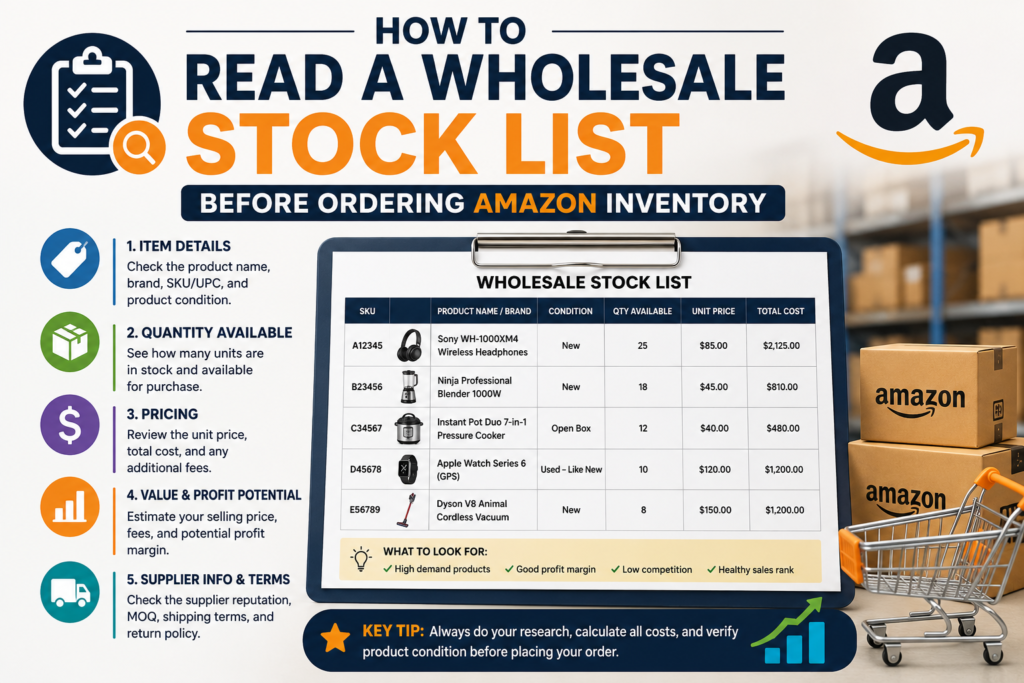
Receiving a wholesale stock list can feel exciting, especially when it contains hundreds or thousands of branded products. You may see attractive unit prices, familiar brands, estimated profits, and products that already have active Amazon listings. However, a long stock list is not automatically a list of profitable buying opportunities. The supplier may provide useful information, but Amazon sellers must still review each product carefully. A low wholesale price does not matter if the item has selling restrictions, poor demand, unstable pricing, high FBA fees, incorrect listing information, or limited available stock. The goal is not to order the largest number of products. It is to identify products that fit your Amazon account, budget, sourcing strategy, and acceptable level of risk. This guide explains how to read a wholesale stock list properly, understand the most common columns, shortlist suitable products, calculate realistic costs, and avoid expensive inventory mistakes. Quick Answer How do you read a wholesale stock list for Amazon FBA? Start by reviewing the product name, brand, supplier SKU, UPC or EAN, wholesale price, minimum order quantity, case pack, available quantity, and product condition. Next, match each product to the correct Amazon ASIN and check: Always confirm important product details with the distributor before ordering. Amazon requirements may vary by category, brand, seller account, ASIN, and marketplace. What Is a Wholesale Stock List? A wholesale stock list is a document or digital file showing products currently available from a wholesaler or distributor. It may be provided as: The list normally contains product-identification, inventory, and pricing information. Some distributors may also include Amazon-related data such as ASINs, sales rank, estimated fees, profit, or return on investment. However, sellers should treat any Amazon data in the stock list as a starting point rather than a final buying decision. Prices, fees, competition, restrictions, and sales activity can change. AI Snippet Answer: What Information Should a Wholesale Stock List Include? A useful wholesale stock list should include the product name, brand, supplier SKU, UPC or EAN, unit price, case quantity, minimum order quantity, available stock, product condition, and ordering instructions. Amazon-focused lists may also include the ASIN, Buy Box price, sales rank, estimated fees, profit, and ROI. Sellers should independently verify important data before placing an order. Why Reading the Stock List Properly Matters A stock list helps you compare many products quickly, but every column affects the final buying decision. Misreading a single detail can lead to: In our previous guide about product authenticity and wholesale sourcing, we explained why traceable inventory and reliable documentation matter. Reading the stock list carefully is another part of that process because it helps you connect the product, supplier SKU, barcode, invoice, and Amazon listing correctly. A clean product match can also help sellers maintain better sourcing records if Amazon later requests supporting information. How to Read a Wholesale Stock List Step by Step Step 1: Understand the Column Headings Before analyzing individual products, review every column in the document. Common stock-list columns include: Do not assume that every distributor uses the same format. For example, “Price” could mean the cost of one unit, one inner pack, or one complete case. “Quantity” could mean individual sellable units or the number of cases available. Ask the distributor for clarification when a column is unclear. Step 2: Confirm the Product Identifier The most important part of product matching is the identifier. Useful identifiers include: Search the UPC or manufacturer part number and compare the wholesale product with the Amazon detail page. Check the: Do not rely only on the product title. Two products may have nearly identical names but different pack sizes, formulas, colors, or barcodes. Step 3: Check the Unit Cost and Case Pack Suppose a stock list shows: The true unit cost is $5, but the minimum initial product spend is $240 for 48 units. Some lists show the unit cost separately. Others only show case pricing. Use this basic formula: Unit cost = Total case cost ÷ Number of units in the case Then confirm whether additional charges apply, including: The listed wholesale price is only the beginning of your total inventory cost. Step 4: Review the Minimum Order Quantity The minimum order quantity, or MOQ, is the smallest quantity the distributor allows you to purchase. An MOQ may apply: A product may appear profitable, but an MOQ of 100 or 200 units could create unnecessary inventory risk for a new seller. Always calculate: Estimated months of stock = Units ordered ÷ Realistic monthly sales If a listing appears to sell 100 units per month but has five competitive sellers, do not assume your offer will receive all 100 sales. Step 5: Check Available Stock Available quantity shows how much inventory the distributor currently has. This number matters for two reasons. First, limited stock may prevent consistent reordering. Second, extremely high stock does not mean you should place a large opening order. Ask whether: A product with healthy demand is more useful when it can be replenished consistently. Step 6: Verify Your Amazon Selling Eligibility Before calculating profit, search the exact ASIN through your Amazon seller account. Check whether you can list the product or whether Amazon displays: Do not assume that access to a category means access to every brand or ASIN within it. A commercial invoice from a legitimate distributor may help support approval requests, depending on Amazon’s requirements. It does not guarantee ungating or approval. Step 7: Analyze the Current Amazon Price Many stock lists include an Amazon price, but you should check it yourself. Review: Avoid calculating profit using only the highest price shown during a temporary stock shortage. Use a conservative selling price based on normal market conditions. Step 8: Review Competition A listing with strong demand can still be difficult when competition is high. Check: More sellers do not always make a product unsuitable, but they can reduce your share of sales and create pricing pressure. Step 9: Understand Sales Rank Sales rank can help indicate demand, but