
Seasonal demand can create some of the best sales opportunities for Amazon wholesale sellers, but it can also expose weaknesses in an inventory plan.
Order too late, and your products may arrive after demand has peaked. Order too much, and you may be left paying storage costs on inventory that is difficult to sell once the season ends. Even when the product itself is profitable, poor timing can reduce the return on your purchase.
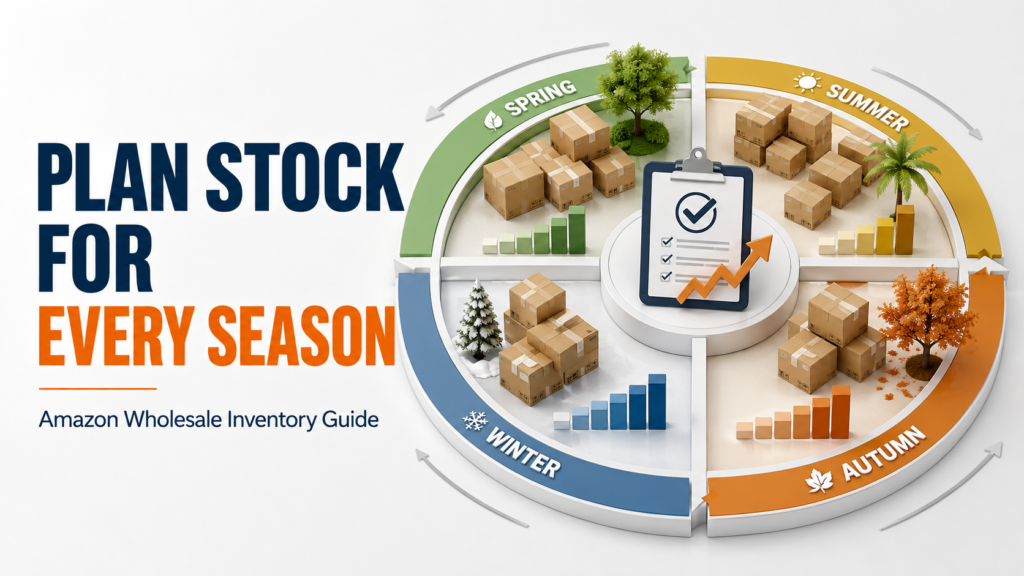
Effective seasonal inventory planning is therefore not about buying the largest possible quantity. It is about understanding when demand may change, calculating how long replenishment actually takes, and ordering an amount your business can sell and finance responsibly.
This guide explains how Amazon FBA wholesale sellers can build a practical seasonal inventory plan without relying on guesswork or unrealistic forecasts.
Quick Answer: How Should Amazon Sellers Plan Seasonal Inventory?
Amazon sellers should plan seasonal inventory by reviewing historical sales, identifying the expected demand window, calculating total supplier-to-Amazon lead time, setting product-specific reorder points, and maintaining an appropriate safety-stock buffer.
A practical seasonal inventory plan should include:
- Historical sales during similar periods
- Recent sales velocity
- The expected start and end of seasonal demand
- Supplier processing and shipping time
- Prep-center and Amazon receiving time
- Available, inbound, and reserved inventory
- Product profitability and storage exposure
- Safety stock for delays or unexpected demand
- A plan for leftover inventory after the season
The best order quantity depends on the product, marketplace, available capital, supplier terms, and the reliability of the available sales data.
What Is Seasonal Inventory Planning?
Seasonal inventory planning is the process of forecasting demand and scheduling inventory purchases around predictable changes in customer buying behavior.
These changes may be connected to:
- Holidays
- Weather conditions
- Back-to-school shopping
- Travel periods
- Sporting events
- Gift-buying occasions
- Amazon sales events
- Annual promotions
- New-year demand
- Changes in household routines
Some products have an obvious season. Winter accessories, outdoor products, school supplies, and holiday gift items are common examples. Other products experience less visible demand changes that may still affect sales.
For example, a product may sell throughout the year but experience a significant increase during a particular month. That makes it seasonally influenced even if it is not strictly a seasonal item.
The purpose of seasonal planning is to have enough sellable inventory available when demand increases while limiting the amount left after demand returns to normal.
Seasonal Inventory vs Regular Inventory
Regular inventory planning often uses relatively stable sales averages. Seasonal planning must account for temporary increases and decreases.
A regular forecast may ask:
How many units do we normally sell each week?
A seasonal forecast asks:
How many units may sell before, during, and after this specific demand period?
That difference matters because using an annual average can hide important demand changes. A product averaging 100 monthly sales may sell far more during one season and much less during the rest of the year.
Why Seasonal Inventory Planning Matters for Amazon FBA Sellers
Seasonal opportunities operate within a limited time. Sellers who miss the demand window cannot always recover those sales by restocking later.
It Helps Reduce Stockout Risk
A seasonal stockout can be more difficult to recover from than a regular stockout because the strongest demand may last only a few weeks.
If the replacement shipment reaches Amazon after the peak, the seller may miss the main opportunity and still be left with inventory during a slower period.
Planning early provides more time for:
- Supplier processing
- Product preparation
- Freight delays
- Amazon appointment scheduling
- Fulfilment-centre receiving
- Inventory transfers
- Unexpected demand changes
It Protects Working Capital
Buying deeply into a seasonal product may tie up money that is needed for regular inventory. If the seasonal units sell slowly, the seller may be unable to reorder consistent year-round products.
A strong inventory plan evaluates the complete cash commitment rather than looking only at the wholesale price per unit.
It Can Reduce Excess Inventory
Seasonal products may lose demand quickly. They can also face increased competition as multiple sellers reduce prices to clear remaining stock.
Planning an exit strategy before purchasing helps sellers decide:
- The maximum quantity they can safely buy
- The latest date for placing a reorder
- When to reduce promotional activity
- Whether a second order is still practical
- How to manage stock remaining after the season
It Supports Better Advertising Decisions
Advertising and inventory planning should work together. Increasing PPC activity when stock is limited may cause the product to sell out too early. Continuing aggressive advertising after seasonal demand weakens may reduce margins unnecessarily.
Inventory data can help sellers decide when to increase, maintain, or reduce advertising activity.
It Encourages More Organized Sourcing
Seasonal urgency can push sellers toward unfamiliar suppliers. However, product authenticity and sourcing documentation should not be sacrificed simply to obtain stock quickly.
Purchasing through a legitimate wholesale source can help sellers keep better sourcing records. Commercial invoices may help support approval requests depending on Amazon’s requirements, but they do not guarantee ungating, approval, or acceptance. Requirements may vary by product, category, marketplace, and seller account.
Step-by-Step Seasonal Inventory Planning Guide
1. Build a Seasonal Calendar
Start by listing the demand periods relevant to your products.
Your calendar may include:
- Major holidays
- Amazon sales events
- School terms
- Weather transitions
- Travel seasons
- Gift-buying periods
- Industry events
- Supplier closures
- Freight cut-off dates
Do not focus only on the date of the event. Work backwards from the point when inventory needs to be available for sale.
If customer demand normally begins four weeks before a holiday, your inventory should be sellable before that four-week window starts—not delivered to Amazon on the holiday itself.
2. Review Historical Sales Data
Examine how the product performed during the same period in previous years, if that data is available.
Review:
- Units sold by week
- Sales before the peak
- The highest-sales week
- The speed of decline after the peak
- Selling-price changes
- Advertising activity
- Stockout periods
- Competitor activity
- Returns and refunds
- Units remaining after the season
Historical data is useful, but it should not be copied blindly. Last year’s results may have been affected by pricing, advertising, competition, stock availability, or changing consumer interest.
Sellers should compare historical performance with current demand and competition. The guide to product demand vs competition for Amazon FBA provides additional context for evaluating both factors before committing to inventory.
3. Calculate Current Sales Velocity
Sales velocity shows how quickly a product is currently selling.
Average daily sales = Units sold during a period ÷ Number of days
If a product sold 210 units during the previous 30 days:
210 ÷ 30 = 7 units per day
Compare several periods:
- Previous 7 days
- Previous 30 days
- Previous 60 or 90 days
- The same seasonal period from the previous year
- Recent promotional periods
Recent data shows current momentum, while longer timeframes help determine whether that momentum is stable.
4. Estimate Seasonal Demand Conservatively
Use historical performance, recent sales, and known seasonal changes to create a reasonable forecast.
Instead of relying on one number, create three scenarios:
- Conservative forecast: Demand is weaker than expected
- Expected forecast: Demand follows the most realistic pattern
- High-demand forecast: Sales increase beyond the expected level
This approach helps sellers understand the possible range of outcomes.
A forecast should guide a decision, not create false confidence. No calculation can predict competitor pricing, sudden trends, supplier delays, or unexpected changes in customer demand perfectly.
For more detail on building forecasts from sales records, review these inventory forecasting tips for Amazon wholesale sellers.
5. Calculate the Complete Replenishment Lead Time
The replenishment lead time is the total time between deciding to purchase inventory and having sellable units available on Amazon.
It may include:
- Internal purchasing approval
- Supplier order processing
- Product preparation
- Labeling or bundling
- Shipping to a prep centre
- Prep-centre processing
- Transportation to Amazon
- Fulfilment-centre receiving
- Inventory transfers
A common mistake is to count only shipping time. A supplier may dispatch an order quickly, but the units can still experience delays before they become available for customers.
Use a realistic lead time based on previous orders, and add extra time during busy periods.
6. Set a Seasonal Reorder Point
A reorder point identifies when another purchase order should be placed.
Reorder point = Average daily sales × Total lead time + Safety stock
For example, suppose a product sells 12 units per day during the seasonal period, replenishment requires 25 days, and the seller keeps 60 units of safety stock:
12 × 25 + 60 = 360 units
The seller should consider reordering when available inventory approaches 360 units.
This calculation should be adjusted as sales velocity changes. Each SKU needs its own reorder point because demand, lead time, and supply risk differ.
The previous guide explaining how often Amazon sellers should reorder wholesale inventory can help sellers connect reorder frequency with product-specific demand and replenishment time.
7. Add Appropriate Safety Stock
Safety stock is additional inventory held to cover unexpected demand or supply delays.
It may be useful when:
- Seasonal demand rises earlier than expected
- Sales exceed the forecast
- A supplier requires more processing time
- A shipment is delayed
- Amazon receiving takes longer than usual
- Some units become damaged or unsellable
The amount should be based on risk rather than a fixed percentage applied to every product.
A stable product with a short lead time may need a smaller buffer. A fast-moving seasonal product with an uncertain lead time may require more protection.
However, excessive safety stock can become leftover seasonal inventory. Review the buffer as the end of the season approaches.
8. Separate Available and Inbound Inventory
Do not treat all units in your inventory system as immediately sellable.
Track these statuses separately:
- Available inventory
- Inbound inventory
- Reserved units
- Units being transferred
- Unsellable units
- Inventory at a prep centre
- Confirmed supplier stock
- Ordered but unshipped products
Your seasonal plan should show where each group of units is located and when it is expected to become available.
9. Review Profitability Before Increasing an Order
A product selling quickly is not automatically a good reorder opportunity.
Before buying additional units, review:
- Wholesale product cost
- Amazon referral and fulfilment fees
- Inbound freight
- Prep and labeling expenses
- Advertising costs
- Expected selling price
- Return exposure
- Storage considerations
- Expected profit per unit
- Time remaining in the season
If only a short demand window remains, a new order may arrive too late to sell at the expected price.
10. Use Staggered Orders When Practical
Instead of buying the entire forecasted quantity at once, sellers may divide the purchase into stages when supplier terms and logistics make this practical.
For example:
- First order for early demand
- Second order after confirming sales velocity
- Final smaller order only if enough seasonal demand remains
Staggered ordering can help sellers:
- Protect working capital
- Respond to real sales data
- Reduce leftover inventory
- Limit dependence on one shipment
- Adjust when demand changes
Minimum order quantities, case packs, freight costs, and product availability must be considered before using this approach.
11. Decide Your Final Reorder Date
Every seasonal product should have a final date after which another order is unlikely to make sense.
To determine it, consider:
- Remaining time in the demand window
- Complete replenishment lead time
- Current sales velocity
- Expected post-season demand
- Existing inbound inventory
- Potential storage exposure
- Realistic profit after the peak
Without a final reorder date, sellers may continue replenishing based on strong current sales even when future inventory will arrive after demand declines.
12. Create a Post-Season Plan
Decide what you will do if inventory remains after the seasonal period.
Possible actions may include:
- Returning to normal pricing and advertising levels
- Reducing future reorder quantities
- Holding suitable year-round products
- Reviewing removal options
- Adjusting promotions
- Reallocating inventory where appropriate
- Recording the results for next year’s forecast
Avoid waiting until the season ends to think about leftover stock. The exit plan should be part of the original purchasing decision.
Common Seasonal Inventory Mistakes to Avoid
Ordering Too Late
Inventory delivered during the peak may not become sellable until demand begins to decline. Work backwards from the required availability date.
Treating Last Year’s Sales as a Guarantee
Historical data provides context, not certainty. Competition, pricing, advertising, and customer preferences may have changed.
Overreacting to a Short Sales Spike
Several strong days do not always indicate sustained seasonal demand. Compare the increase with longer sales periods before making a large commitment.
Ordering Extra Units Only for a Discount
A lower unit price is valuable only when the additional stock can sell profitably. Calculate the total investment and expected sell-through time.
Ignoring Amazon Receiving Delays
Inventory delivered to Amazon is not always immediately available. Include receiving and transfer time in your plan.
Using the Same Buffer for Every Product
Each SKU has different demand variability, supplier reliability, and post-season risk. Set safety stock individually.
Forgetting the End of the Season
Sellers often focus on preparing for peak demand but fail to plan for the decline. Set a final reorder date and maximum inventory level before the season begins.
How a Verified Wholesale Distributor Can Help
A verified distributor cannot remove every seasonal inventory risk, but a reliable sourcing relationship can make planning more structured.
Working with an established wholesale source may help sellers:
- Source authentic wholesale products
- Confirm current product availability
- Understand case-pack quantities
- Review minimum order requirements
- Plan around realistic processing times
- Maintain commercial purchasing records
- Receive invoices for completed orders
- Coordinate prep and labeling requirements
- Build a repeatable seasonal sourcing process
Accurate supplier communication is especially important before major demand periods. Sellers should confirm stock availability, processing time, holiday closures, shipping schedules, and documentation before placing an order.
You can learn more about the company and its wholesale approach on the About EN Distributions page. Sellers can also review the available Amazon FBA wholesale services for information about fulfilment, preparation, labeling, sourcing, and support.
Supplier invoices and supporting records may help support approval requests depending on Amazon’s requirements. They do not guarantee ungating, product approval, account approval, or document acceptance. Requirements may vary by category, marketplace, product, brand, and seller account.
Final Thoughts
Seasonal inventory planning requires more than ordering additional units before a holiday or sales event. Sellers must understand when demand begins, how long replenishment takes, how much inventory the business can finance, and what will happen to unsold units after the season.
Start with a practical process:
- Build a seasonal calendar
- Review historical and recent sales
- Create conservative, expected, and high-demand forecasts
- Calculate complete lead time
- Set product-specific reorder points
- Maintain appropriate safety stock
- Track available and inbound units separately
- Establish a final reorder date
- Create a post-season inventory plan
No seasonal forecast will be perfect. The goal is to reduce avoidable surprises and make purchasing decisions using the best information currently available.
To explore current product categories and wholesale sourcing information, visit EN Distributions. If you are ready to begin sourcing, you can apply for a wholesale account. You can also contact EN Distributions to ask about product availability, order requirements, processing times, or wholesale documentation.
Frequently Asked Questions
1. When should Amazon sellers order seasonal inventory?
Sellers should work backwards from the date inventory must be sellable. Include supplier processing, preparation, shipping, Amazon receiving, and an appropriate delay buffer when deciding when to order.
2. How do I forecast seasonal demand for Amazon FBA?
Compare historical seasonal sales with recent sales velocity, current competition, pricing, advertising, and available inventory. Use conservative, expected, and high-demand scenarios instead of relying on one forecast.
3. How much seasonal safety stock should I keep?
The right amount depends on demand variability, total lead time, supplier reliability, available working capital, and the risk of leftover inventory. Safety stock should be calculated for each SKU.
4. Should I place one large seasonal order or several smaller orders?
Staggered orders may reduce risk and improve cash-flow control when supplier terms, minimum quantities, shipping costs, and lead times allow. Large orders may be practical only when demand is well supported by reliable data.
5. Can wholesale invoices help with Amazon approval requests?
Commercial invoices from a legitimate wholesale source can help sellers keep better sourcing records and may help support approval requests depending on Amazon’s requirements. Approval or ungating is not guaranteed.
One Response